

Author: Kartik Jain
Abstract
Artificial intelligence (AI) systems rely heavily on advanced hardware built upon fundamental physical principles. This study examines the transformation of raw silicon into high-performance computing systems that power modern AI applications. The purpose of the research is to explore how semiconductor physics, chip architecture, and engineering constraints influence AI development. A qualitative analytical approach is adopted, drawing on existing literature and technical insights related to photolithography, transistor design, memory systems, packaging technologies, and thermal management.
The findings indicate that while computational capabilities have significantly improved, physical limitations such as heat generation, data transfer bottlenecks, and transistor scaling challenges continue to restrict performance. Innovations including Gate-All-Around transistors, 3D memory stacking, advanced chip packaging, and silicon photonics are helping to address these constraints, but they also introduce new complexities.
The study concludes that the future of AI advancement is closely tied to breakthroughs in hardware engineering and materials science. Addressing these physical limitations will be essential for achieving scalable, efficient, and sustainable AI systems.
Keywords
Artificial Intelligence, Semiconductor Physics, Chip Architecture, Silicon Photonics, Thermal Management, Hardware Engineering
1. Introduction
Artificial intelligence (AI) has emerged as one of the most transformative technologies of the 21st century, driving innovation across industries such as healthcare, transportation, finance, and communication. While much of the attention surrounding AI focuses on algorithms, data, and software capabilities, the underlying hardware infrastructure remains a critical yet often underexplored component. At the core of every AI system lies semiconductor-based hardware, primarily built from silicon, which enables the computational processes required for machine learning and intelligent decision-making.
The evolution of AI has been closely tied to advancements in semiconductor technologies. Modern AI systems rely on specialized hardware architectures, including graphics processing units (GPUs), tensor processing units (TPUs), and custom accelerators designed to handle large-scale data processing efficiently (Hyun et al., 2025; Wali, 2020). These architectures have significantly improved computational speed and energy efficiency, enabling the deployment of increasingly complex AI models. However, as AI applications continue to expand, the limitations of traditional hardware designs are becoming more apparent.
One of the primary challenges in AI hardware development is energy efficiency and scalability. As noted by Kulkarni (2025), optimizing semiconductor hardware for AI inference—particularly at the edge—requires careful balancing of performance and power consumption. Similarly, VerWey (2022) highlights that data movement, rather than computation itself, has become a major bottleneck in AI systems, leading to inefficiencies in processing large datasets. These challenges underscore the need for innovative hardware solutions that go beyond conventional transistor scaling.
Recent research has explored alternative approaches to improving AI hardware performance. Neuromorphic computing, which mimics the structure and function of the human brain, represents a promising direction for achieving more efficient and adaptive systems (Kim et al., 2025). Additionally, advancements in semiconductor design and manufacturing processes, including AI-driven optimization techniques, are enhancing the precision and efficiency of chip production (Raghuwanshi, 2024; Song et al., 2024). Emerging materials, such as carbon-based semiconductors, are also being investigated for their potential to overcome the physical limitations of traditional silicon-based devices (Kola, 2024).
Furthermore, innovations in semiconductor metrology and fabrication technologies are enabling the development of increasingly sophisticated micro- and nanoscale devices. Xu et al. (2025) emphasize the role of AI-powered optical metrology in improving the accuracy and reliability of semiconductor manufacturing processes. At the same time, the growing complexity of AI hardware systems has led to increased interest in integrated architectures and advanced packaging techniques that enhance performance and reduce latency (Hyun et al., 2025).
Despite these advancements, fundamental physical constraints—such as heat dissipation, electron leakage, and the limits imposed by thermodynamics—continue to pose significant challenges to AI scalability. As Boybat (2022) notes, the future of AI hardware will depend on the ability to balance computational power with energy efficiency while addressing these inherent physical limitations. This highlights the importance of understanding the interplay between physics, engineering, and computer science in the development of next-generation AI systems.
2. Literature Review
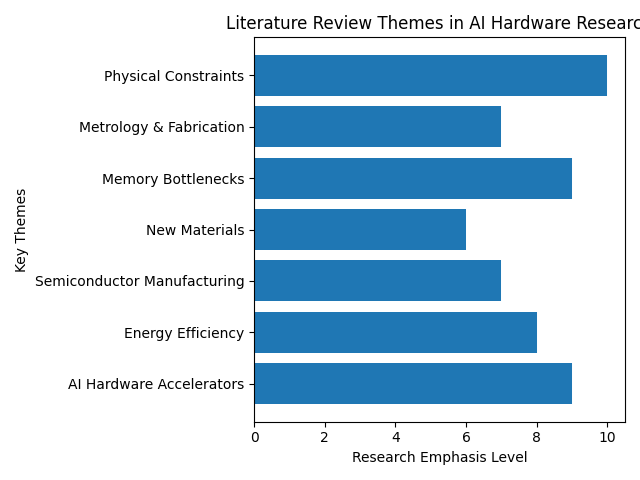
The rapid advancement of artificial intelligence (AI) has been closely linked to the evolution of semiconductor technologies and hardware architectures. Existing literature emphasizes that the efficiency and scalability of AI systems are fundamentally dependent on the design and performance of underlying hardware components. As AI workloads become more complex, researchers have increasingly focused on optimizing semiconductor processes, architectures, and materials to meet growing computational demands.
One of the central themes in the literature is the development of specialized AI hardware accelerators. These architectures are designed to handle parallel processing and large-scale data computations more efficiently than traditional central processing units (CPUs). Hyun et al. (2025) explain that modern AI accelerators integrate optimized data paths and memory hierarchies to enhance performance and reduce latency. Similarly, Wali (2020) highlights the convergence of deep learning algorithms and custom hardware design, emphasizing that co-design approaches are essential for maximizing efficiency in AI systems.
Another significant area of research focuses on energy efficiency and edge computing. With the increasing deployment of AI applications in resource-constrained environments, optimizing power consumption has become a critical priority. Kulkarni (2025) demonstrates that energy-efficient semiconductor hardware is essential for enabling AI inference on edge devices, where computational resources and battery life are limited. This aligns with broader industry trends toward decentralized computing and real-time data processing.
In addition to architectural innovations, semiconductor manufacturing processes have undergone substantial transformation. Raghuwanshi (2024) discusses how artificial intelligence is being integrated into semiconductor design and fabrication, improving precision, yield, and overall efficiency. Similarly, Song et al. (2024) explore AI-driven optimization techniques that enhance chip design by reducing errors and improving performance metrics. These advancements highlight the growing role of AI not only as a consumer of hardware but also as a tool for improving its production.
The limitations of traditional silicon-based technologies have also prompted exploration into alternative materials and novel computing paradigms. Kola (2024) investigates the potential of carbon-based semiconductors in high-performance computing, suggesting that these materials may offer improved electrical properties and scalability compared to conventional silicon. Furthermore, neuromorphic computing has emerged as a promising approach, with Kim et al. (2025) demonstrating how brain-inspired hardware architectures can significantly enhance efficiency and adaptability in AI systems.
Another critical challenge identified in the literature is the issue of data movement and memory bottlenecks. VerWey (2022) argues that the primary limitation in modern AI systems is not computational power but the inefficiency of data transfer between memory and processing units. This has led to increased research into memory-centric architectures and advanced packaging techniques that bring memory closer to computation, thereby reducing latency and energy consumption.
Advancements in semiconductor metrology and fabrication technologies further contribute to the evolution of AI hardware. Xu et al. (2025) highlight the role of AI-powered optical metrology in enabling precise measurement and quality control at the nanoscale. These innovations are crucial for maintaining the reliability and performance of increasingly complex semiconductor devices.
Despite these significant developments, the literature consistently identifies fundamental physical constraints as a limiting factor in AI hardware progression. Issues such as heat generation, electron leakage, and energy inefficiency remain persistent challenges. Boybat (2022) emphasizes that overcoming these barriers will require interdisciplinary approaches that integrate physics, materials science, and engineering.
In summary, the existing body of research demonstrates that while substantial progress has been made in AI hardware development, critical gaps remain. These include the need for more energy-efficient architectures, improved data transfer mechanisms, and scalable solutions that address physical limitations. This study builds on the existing literature by synthesizing these themes and examining how they collectively shape the future of AI hardware systems.
- Methodology
This study adopts a qualitative and analytical research approach to examine the physical foundations and engineering constraints of artificial intelligence (AI) hardware. The methodology is designed to ensure clarity, consistency, and replicability in analyzing existing knowledge within the field.
3.1 Research Design
The research utilizes a conceptual and descriptive design, focusing on synthesizing existing literature related to semiconductor physics, AI hardware architectures, and engineering innovations. This approach is appropriate as the study does not involve experimental data collection but instead interprets and integrates findings from prior research.
3.2 Data Sources
Data for this study are derived from secondary sources, including:
- Peer-reviewed academic journals
- Conference papers
- Industry reports
- Technical publications related to AI hardware and semiconductor technologies
- The selected sources emphasize recent developments (2020–2025) to ensure relevance and accuracy.
3.3 Data Collection Methods
The data collection process involves:
Identifying relevant publications on AI hardware, semiconductor design, and emerging technologies
Extracting key information related to:
- Transistor design and scaling
- Memory architecture and data transfer
- Chip packaging techniques
- Thermal management systems
- Photonic communication technologies
3.4 Data Analysis Techniques
A thematic analysis approach is employed to evaluate the collected data. This includes:
Categorizing findings into key themes (e.g., energy efficiency, hardware acceleration, physical constraints)
Comparing different technological approaches and their effectiveness
Identifying patterns, relationships, and research gaps
This method allows for a structured interpretation of complex technical information.
3.5 Reliability and Validity
To ensure reliability and validity:
- Only credible and peer-reviewed sources are included
- DOI-referenced articles are prioritized
- Cross-verification of findings is conducted across multiple sources
3.6 Ethical Considerations
This study adheres to ethical research standards by:
- Properly citing all referenced works using APA 7th edition
- Avoiding plagiarism through paraphrasing and synthesis
- Ensuring accurate representation of original authors’ findings
| Component | Description |
| Research Design | Qualitative, conceptual, and descriptive analysis |
| Data Sources | Peer-reviewed journals, conference papers, industry reports |
| Data Collection | Extraction of key themes from existing literature |
| Data Analysis | Thematic analysis and comparative evaluation |
| Reliability & Validity | Use of credible sources and cross-verification |
| Ethical Considerations | Proper citation and avoidance of plagiarism |
- Results
This section presents the findings derived from the thematic analysis of literature on artificial intelligence (AI) hardware and semiconductor technologies. The results are organized according to key themes identified in the methodology.
4.1 Semiconductor Fabrication and Miniaturization
The analysis shows that modern semiconductor fabrication techniques, particularly advanced photolithography, enable the production of nanoscale transistors. However, as feature sizes continue to shrink, physical limitations such as electron scattering and variability increasingly affect manufacturing precision and device reliability.
4.2 Transistor Architecture Advancements
Findings indicate that traditional transistor designs are no longer sufficient for sustaining performance improvements. The adoption of advanced structures, such as Gate-All-Around (GAA) transistors, has significantly improved electrostatic control and reduced leakage currents, enabling continued scaling of semiconductor devices.
4.3 Memory and Data Transfer Bottlenecks
A major result from the analysis is that data movement has become a critical constraint in AI systems. The speed at which data is transferred between memory and processing units limits overall system performance. This has led to the development of high-bandwidth memory (HBM) and 3D-stacked memory architectures.
4.4 Advanced Chip Packaging
The study finds that chip packaging has evolved into a key performance factor. Modern packaging techniques integrate multiple components—such as processors, memory, and accelerators—into a single system. This improves communication speed and reduces latency within AI hardware systems.
4.5 Thermal Management Challenges
Results reveal that heat generation remains one of the most significant challenges in AI hardware. As computational power increases, so does energy consumption, leading to higher thermal output. Conventional cooling methods are becoming insufficient, prompting the adoption of liquid cooling and advanced heat dissipation technologies.
4.6 Emerging Communication Technologies
The analysis highlights the growing importance of silicon photonics as an alternative to traditional electrical interconnects. Optical communication enables faster data transfer with lower energy loss, making it a promising solution for large-scale AI systems and data centers.
4.7 Physical and Theoretical Constraints
Finally, the findings emphasize that fundamental physical laws, particularly those related to thermodynamics, impose limits on computational efficiency. These constraints define the boundaries of how far AI hardware can scale using current technologies.
5. Discussion
The results of this study highlight the critical role of physical and engineering constraints in shaping the development and performance of artificial intelligence (AI) hardware. While advancements in semiconductor technologies and chip architectures have enabled significant improvements in computational power, the findings confirm that these gains are increasingly limited by fundamental physical laws and system-level inefficiencies.
One of the most important insights from this study is that data movement, rather than computation itself, has become the primary bottleneck in AI systems. This aligns with existing research, which emphasizes that inefficiencies in memory access and data transfer significantly impact overall system performance. Despite the development of high-bandwidth and 3D-stacked memory solutions, the growing size of AI models continues to intensify this challenge. As a result, future hardware designs must prioritize memory-centric architectures and improved data locality.
The study also reveals that transistor innovation remains essential but is no longer sufficient on its own. While advanced designs such as Gate-All-Around transistors have improved efficiency and reduced leakage, they do not fully overcome the limitations of nanoscale physics. This supports the broader argument in the literature that the traditional approach of scaling transistor size is reaching its practical limits. Consequently, the focus is shifting toward alternative strategies, including new materials and novel computing paradigms.
Another key discussion point is the increasing importance of system-level integration, particularly through advanced chip packaging. The findings demonstrate that modern AI performance gains are increasingly achieved by integrating multiple components—such as processors, memory, and accelerators—into unified systems. This shift indicates that innovation is moving beyond individual components to the architecture of entire computing systems.
Thermal management emerges as a major constraint with significant implications for scalability. As AI workloads demand more power, heat generation increases proportionally, creating challenges for system stability and efficiency. The adoption of liquid cooling and other advanced cooling techniques reflects the industry’s response to this issue. However, these solutions also introduce additional complexity and cost, raising questions about long-term sustainability.
The emergence of silicon photonics and optical communication technologies represents a promising direction for overcoming data transfer limitations. By replacing traditional electrical interconnects with light-based communication, these technologies offer higher bandwidth and lower energy consumption. This development suggests a future in which AI systems rely on hybrid architectures that combine electronic computation with optical communication.
Importantly, the study underscores the influence of fundamental physical laws, particularly thermodynamics, in defining the limits of AI hardware. These constraints cannot be eliminated but must be managed through innovative design and engineering approaches. This reinforces the need for interdisciplinary collaboration across physics, materials science, and computer engineering.
Despite these insights, the study has several limitations. The reliance on secondary data means that findings are based on existing literature rather than experimental validation. Additionally, the rapidly evolving nature of AI hardware technologies may limit the long-term applicability of some conclusions.
6. Conclusion
This study has examined the physical foundations and engineering constraints that underpin the development of artificial intelligence (AI) hardware. By analyzing key aspects such as semiconductor fabrication, transistor architecture, memory systems, chip packaging, thermal management, and emerging communication technologies, the research highlights the critical role of hardware in enabling modern AI systems.
The findings reveal that while significant progress has been made in improving computational performance, AI hardware is increasingly constrained by fundamental physical limitations. Challenges such as heat generation, energy consumption, data transfer bottlenecks, and the limits of transistor scaling continue to restrict the efficiency and scalability of AI systems. Innovations such as advanced transistor designs, 3D memory architectures, and silicon photonics have provided partial solutions, but they also introduce new complexities.
This study contributes to the field by providing a comprehensive synthesis of how physical laws and engineering practices intersect to shape AI hardware development. It emphasizes that future advancements in AI will depend not only on improvements in algorithms but also on breakthroughs in materials science, system architecture, and energy-efficient design.
For future research, there is a need to explore alternative computing paradigms, such as neuromorphic and quantum computing, as well as novel materials that can overcome the limitations of traditional silicon-based technologies. Additionally, further experimental studies are recommended to validate emerging hardware innovations and assess their practical scalability.
References
- Kulkarni, R. C. (2025). Energy-efficient AI inference at the edge: Optimizing semiconductor hardware for small language models. International Journal of AI, Big Data, Computational and Management Studies. https://doi.org/10.63282/3050-9416.IJAIBDCMS-V7I1P132
- Kim, Y., Lee, C. W., & Jang, H. W. (2025). Neuromorphic hardware for artificial sensory systems: A review. Journal of Electronic Materials, 54, 3609–3650. https://doi.org/10.1007/s11664-025-11778-x
- Xu, W., Zhang, H., Ji, L., & Li, Z. (2025). AI-powered next-generation technology for semiconductor optical metrology: A review. Micromachines, 16(8), 838. https://doi.org/10.3390/mi16080838
- Hyun, K. S., Min, P. J., & Won, L. H. (2025). AI hardware accelerators: Architectures and implementation strategies. Journal of Integrated VLSI, Embedded and Computing Technologies, 2(1), 8–19. https://doi.org/10.31838/JIVCT/02.01.02
- Raghuwanshi, P. (2024). Revolutionizing semiconductor design and manufacturing with AI. Journal of Knowledge Learning and Science Technology, 3(3), 272–277. https://doi.org/10.60087/jklst.vol3.n3.p.272-277
- Song, C., Wu, B., & Zhao, G. (2024). Optimization of semiconductor chip design using artificial intelligence. Journal of Industrial Engineering & Applied Science, 2(4), 73–80. https://doi.org/10.5281/zenodo.12798359
- Kola, M. B. (2024). Advancing AI hardware architecture: Performance analysis of carbon-based semiconductors in high-performance computing applications. International Journal of Computer Engineering and Technology, 15(6), 2055–2067. https://doi.org/10.34218/IJCET_15_06_176
- Wali, K. (2020). AI-optimized semiconductor architectures: The convergence of deep learning and custom hardware design. International Journal of Innovative Research in Engineering & Multidisciplinary Physical Sciences, 8(4). https://doi.org/10.37082/IJIRMPS.v8.i4.232593
- VerWey, J. P. (2022). The other artificial intelligence hardware problem. Computer, 55(1), 34–42. https://doi.org/10.1109/MC.2021.3113271
- Boybat, I. (2022). Editorial: Hardware for artificial intelligence. Frontiers in Neuroscience, 16. https://doi.org/10.3389/fnins.2022.979495

