Home Blog Page 38

How to keep track of your wellbeing

Trying to keep track of your wellbeing in your daily life can be hard, especially with all of your commitments and responsibilities. Especially when you’re trying to reach a health-related goal, making the changes necessary can be tricky when you’re working around your everyday responsibilities.

Luckily, as new inventions arise, there are new ways to keep track of your health amongst your busy life. Introducing a few changes can make it easier for you to be on top of your mental and physical health.

Here are some tips that will help you in keeping track of your wellbeing!

Plan your meals

It might be a nuisance, but planning your meals and keeping track of what you eat is a huge part of maintaining your health. Making sure you have a well-balanced diet will give your body the nutrients for it to thrive.

A good diet is the basis for feeling energised and ready to accomplish any task. And nowadays, keeping track of what you eat is easier than ever. There are plenty of mobile applications that allow you to input your meals or plan for the coming week.

Having a plan for what to eat will prevent you from caving when you past a fast food restaurant. Keeping on top of your meals can limit the temptation you feel when you’re on an empty stomach!

Monitor your fitness

Keeping track of your physical activity is important for your health. Exercise has great benefits and is essential for having a healthy body.

It’s easy to pass off going to the gym because you’re feeling lazy or don’t have time. Part of committing to your goals is making time in your schedule to work towards your goals.

Monitoring your fitness can help you keep track on what you need to make up for when the weekend comes. Having a health monitoring application or device such as a smartwatch can help you keep track of how many steps you’ve taken. This can give you an idea of how much more exercise you should be aiming to do.

Establish a regular sleeping schedule

Part of wellbeing is making sure you get enough rest. Sticking to a common bedtime and alarm time is important for establishing this regular schedule.

Often times we lose track of when we actually go to bed. Staying up to play around on your phone or browse social media has become increasingly common, and this can have a negative effect on how we sleep.

It’s important that you stick to your bedtime or at least make sure you are getting enough sleep each night.

Give yourself a break

Giving yourself time to relax and not really do anything is important to keep your stress levels down and recoup. Remember not to take on more responsibilities than you can handle, or remember how to say no.

Having that time to relax, whether it’s by meditating, reading a book, or having a relaxing bath, is important to give your mind and body rest!

Everything you need to know about UTMStack

If you operate an enterprise of any size and in any industry, then you’ll understand perfectly well the importance of cybersecurity. Hundreds of thousands of businesses fail because of internal inefficiencies and poorly structured business models. As it turns out, having strong cybersecurity protections and protocols can go a long way in remedying these concerns. This is where UTMStack comes into the picture – an AI-powered threat management system designed to help small, medium and large companies with protecting their data and sensitive information.

If you’re interested in cybersecurity services and UTMStack more precisely, then here’s everything you’ll want to know about them, including their history, key people and core capabilities.

How it all began

UTMStack has been working in the cybersecurity space for over 15 years. They are still a relatively small company of 16 employees; however, in their short history, they have worked with close to 120 happy clients. Based in the heart of Florida, US, UTMStack is built on strong corporate values, especially friendship, collaboration and commitment. Rick Valdes, the CEO of the company, has been instrumental in fostering the firm’s lively culture and exceptional commercial performance.

Their mission and vision

For UTMStack, making cybersecurity services accessible and affordable for all businesses is their overarching goal. Making that a reality continues to be a welcome challenge for the company. By upskilling their staff and hiring the right talent for the right roles within the company, UTMStack has been able to develop an excellent catalogue of services. These services will ensure that your business is protected from potential data breaches while facilitating access to the best cybersecurity solutions available in the industry.

Why you should choose UTMStack

A lot of competition characterizes the cybersecurity industry. As the global economy transitions to more online, remote-based working and learning, protecting your data and persona/corporate information has only grown in its criticality. Working with a company like UTMStack is no longer a luxury – it’s a necessity, and here are some of the benefits of using their help.

Expertise

One thing that UTMStack has over its competitors is expertise. They’ve been working in the cybersecurity space for over half a decade now, and it’s incredible how much knowledge and experience you can chalk up in that time. As a result, you can rest assured that you have some of the best minds in the industry working on designing solutions for your business.

Customization

Leading on from the first point, UTMStack has developed a formidable reputation for developing effective and reliable custom-made AI solutions for its clients. Tailored cybersecurity products are crucial in terms of building long-term business success since every company is different in terms of needs, business structure and data uses.

Range of services

Regarding their range of services, UTMStack is second to none. Indeed, UTMStack offer SOC as a Service, which focuses on protecting your businesses from cyberattacks 24/7. Their platform coordinates threat detection, incident response systems and rapid remediation capabilities.

They can also help with Dark Web Monitoring, which means UTMStack can protect you from nefarious communities on the dark web. Millions of companies have had their private digital credentials compromised because they have been operating on vulnerable, third-party platforms. By the time law enforcement inform you that your data has been compromised, it is usually too late.

UTMStack can also support you through their reliable Penetration Testing. Competitively priced at $995, UTMStack’s Penetrating Testing will enable them to assess the strength of your internal network by performing fake, simulated attacks on your network. This will expose any vulnerabilities in your system and identify practical solutions to these problems.

Conclusion

So, if you’re worried about the security of your company network, reach out to a company like UTMStack for assistance. As the world moves towards cloud-based hosting and decentralized, data-driven workplace environments, the last thing you want is to be left behind.

Virtual phone systems for small businesses – why you should invest

Virtual phone systems are not reserved for big companies only. They are perfect for just about any business which requires communication in the business as well as to customers, which is essentially most businesses. A virtual phone system can be setup in any business regardless of the size, all you need for the system are computers and an Internet connection. A small business may only have a few employees, but these dedicated few need to be able to do their job efficiently and effectively. This is especially true for a small business as the fewer employees, the more important their functions are.

A virtual phone system can provide this level of functionality as there are many features that come with it that make it preferable over a traditional phone system. One of these features is call forwarding. With traditional phone systems, you have to press a combination of buttons to forward a call to somebody. For customer facing businesses, this is a common occurrence and can be time consuming and inefficient.

With a virtual phone system, you simply have to find the employee contact on the software and with the click of a button, you can forward the call. It makes much more sense to do this than to use a traditional phone system for a small business. Next, a small business will need to have automated messages and systems set up. If you want to be able to compete with other companies, you have to stand out in professionalism and function. An automated messaging system is used by large corporations across the globe, and a small business using this system can help to convey professionalism to your clients. You want to be able to look better than others in order to have a competitive edge over competing businesses. A small business should also look to be as cost effective as possible. When you use a virtual phone system, you are saving costs in comparison to a traditional phone system.

Traditional setups involve buying hardware such as phones and wiring and setting it up in a building or similar environment. The hardware plus the installation costs can set you back a lot. With virtual phone systems, you simply pay a subscription to use the software based on how many users you want and install it on your computers. It is also scalable, as you simply pay for a higher subscription cost if you wish to upgrade the number of users and install it on further devices. This ultimately makes virtual phone systems the more cost effective option and makes sense for a small business.

Virtual phone systems are the future of communication and should be considered for any business small or large. Small businesses can especially benefit for the features of a virtual phone system as described above, and they should be used. If you are a small business, then go ahead and give virtual phone systems a try for yourself.

New York To Double Number Of Electric Charging Stations

New York is announcing that it will double the number of electric vehicle charging stations in the state. The energy commissioner hopes to encourage drivers to turn to clean energy.

Access to a charging station remains a major obstacle that prevents consumers from acquiring an electric car.

If all goes well, electric car users will soon have access to 64 charging stations throughout the state.

The state offers a range of incentives to encourage consumers to purchase a clean energy car.

For example, a $5,000 rebate for the purchase of an electric car or a $6,000 rebate for a hydrogen car.

There is also a help program for installing a charging station at home.

There are approximately 22000 electric, hybrid and hydrogen vehicles in New York. The state ranks second in US- after California – for the number of clean cars, according to the non-profit organization Plug.

How Smart Legal Planning Can Protect Drivers Before And After Accidents Happen

There is a version of driving that feels routine, almost forgettable, until something goes wrong and everything shifts at once. Most people spend years behind the wheel without thinking much about legal exposure, liability, or what they would actually do if they were suddenly dealing with insurance adjusters, police reports, or injuries. The gap between feeling prepared and actually being prepared is wider than most realize, and it tends to show up at the worst possible moment. A little foresight goes a long way, especially when it comes to understanding how legal support fits into the bigger picture of everyday driving.

Why Preparation Matters

Drivers tend to focus on safety features, insurance premiums, and maybe the occasional roadside kit, but legal readiness rarely gets the same attention. That is partly because it feels abstract until it is not. The moment an accident happens, the situation becomes less about what you meant to do and more about what can be proven, documented, and defended.

Having a basic understanding of liability laws in your state can make a real difference. Some states follow comparative fault rules, others lean toward contributory negligence, and those distinctions can impact whether someone recovers damages at all. Even something as simple as how you document the scene can shape the outcome later. Photos, witness information, and a clear account of what happened are not just helpful, they can become central pieces of a case.

There is also a practical side to knowing who you would call. People often wait until after an accident to start researching attorneys, which puts them in a reactive position. Taking the time to identify reputable firms ahead of time removes that scramble and gives you a clearer path forward if something does happen.

Choosing The Right Attorney

Choosing The Right Attorney

Not all legal representation is created equal, and the differences tend to show up in how cases are handled from day one. Some firms move quickly, gather evidence, and communicate clearly, while others take a slower or less organized approach that can frustrate clients and weaken outcomes.

It helps to think of this as more than just hiring someone with a law degree. You are choosing a team that will interpret your situation, negotiate on your behalf, and potentially take your case to court. That requires both technical skill and a certain level of responsiveness that clients often overlook when they are scanning websites or reading reviews.

This is where doing a bit of groundwork pays off. Whether that’s Las Vegas injury lawyers, personal injury lawyers in D.C. or anywhere else, you should look for a firm that has a track record with cases similar to yours, communicates clearly, and does not leave you guessing about next steps. That level of transparency matters more than flashy marketing or big promises.

There is also value in asking direct questions before committing. How often do they go to trial, how do they structure fees, and who will actually be handling your case day to day. Those details can tell you more than any headline claim.

When Accidents Escalate

Not every crash stays simple. Some situations carry layers that make them more legally complex, especially when impairment is involved. A drunk driving accident brings in additional factors, from potential criminal charges to heightened liability considerations that can change how a case unfolds.

These cases tend to move differently because there is often clearer fault, but that does not mean they resolve quickly or easily. Insurance companies may still push back, and damages can become a point of contention depending on the circumstances. Medical costs, lost income, and long term impacts all come into play, and each piece needs to be documented and argued carefully.

There is also an emotional component that people do not always anticipate. Even when liability seems obvious, navigating the process can feel draining. That is where strong legal representation makes a noticeable difference, not just in outcome but in how manageable the process feels along the way.

When Accidents Escalate

Vehicle Choice And Risk

It might seem unrelated, but the type of car you drive can influence both the likelihood of an accident and how a case is evaluated afterward. Some vehicles are statistically involved in more high speed incidents, while others are associated with lower severity outcomes due to safety features or design.

Take a car like the Ford Mustang. It has a long standing reputation for performance and speed, which can be part of the appeal, but it also shows up more frequently in certain types of accident reports. That does not mean the car itself is unsafe, but it does highlight how driver behavior and vehicle capabilities intersect.

From a legal standpoint, those factors can come into play when reconstructing an accident. Speed, handling, and braking performance are often examined alongside driver actions. That context can influence how fault is assigned and how damages are calculated.

Insurance And Reality

Insurance is often treated as a safety net, but it has limits that become clear once a claim is filed. Policies have caps, exclusions, and fine print that can reduce what is actually paid out. That gap between expectation and reality is one of the most common surprises people face after an accident.

Insurance And Reality

Working with an attorney early can help clarify what your policy does and does not cover. It can also prevent missteps in communication with insurers, who are ultimately focused on minimizing payouts. Statements made in the first few days after an accident can carry weight later, sometimes more than people realize in the moment.

There is also the question of timing. Delays in seeking legal advice can lead to missed opportunities to gather evidence or build a stronger case. Acting early tends to create more options, even if the situation seems straightforward at first.

Legal Awareness Pays Off

Most drivers will never need to think about the legal side of driving in any serious way, but for those who do, the difference between being prepared and being caught off guard is hard to ignore. Understanding how accidents are evaluated, how attorneys operate, and how insurance actually works gives you a level of control that is easy to overlook until it matters.

That does not require becoming an expert. It just means taking a few steps ahead of time so you are not making decisions under pressure later.

Driving comes with a level of risk that never fully disappears, but it can be managed with the right awareness and preparation. Knowing how to respond, who to call, and what to expect can turn a chaotic situation into something far more manageable.


Less Than 1% of People Achieve What She Has Once. Dr. Tori Reddy Dodla Has Done It Four Times Over.

By the time most people have figured out their lane, Dr. Tori Reddy Dodla has already built a highway.

There is a particular kind of person who doesn’t just succeed. They accelerate. Only 2% of Americans hold a PhD. Less than 1% ever serve as military officers. Less than 1% ever publish a book. Less than 1% ever reach senior government leadership. She’s done it all.

Her résumé reads less like a career path and more like a series of calculated strikes. A commissioned U.S. Army officer. A PhD in Information Technology. A senior federal leader who shaped how the United States government manages its digital resources. A published author with a book distributed globally through Springer, one of the most prestigious academic publishers in the world. A speaker at elite forums. A certified PMP, and holder of multiple Microsoft and IT certifications. An adjunct professor molding the next generation of technology leaders.

And now, CEO.

She didn’t stumble into any of it. Dr. Dodla embodies what it means to have the Midas touch: not luck, not accident, but an almost supernatural ability to enter a space and make it better, bigger, and more valuable than it was before she arrived.

We sat down with Dr. Dodla to find out what actually drives a woman like this.

Welcome, Dr. Dodla. I want to start out by first thanking you for your service. I appreciate all veterans and what that means for our country. But you weren’t just in the Army, we found that you were a commissioned officer and a Distinguished Military Graduate. You are truly apart of the 1%. What did the military teach you about how you operate?

Discipline. Precision……….the element of surprise. But these are things my father instilled early on. My time on active duty just reinforced that. I learned that the most effective forces don’t announce their next move. They study, they prepare in silence, and then they strike exactly where no one expected. And that’s my brand. I’m full of surprises…..but not chaos, it’s strategy.

And yes, less than 1% of the world’s population ever serves as a commissioned military officer, so I’m very proud of that. It’s an honor that I had the opportunity to serve my country.

Well, I know that you are well educated and your training connects to Carnegie Mellon, which is an amazing school. And your doctoral research is rooted in organizational risk and financial performance. Talk to us about your education and what it built in you.

Yes, I’m in the Chief Data and AI Officer program at Carnegie Mellon and has been great; I’m looking forward to completing the program. But it’s not all just about technology. It’s about people and ROI as well.

With my dissertation, I studied how organizations can reduce risk and simultaneously maximize value in terms of knowledge, information, and AI.

But I want to say that I’m not all theory and I’ve had quite a bit of practical experience.

At this point, I’m not guessing. It’s a matter of me tying all of my experiences together.

Ok, so I see that you have Dodla Digital. Talk to me about your business.

Dodla Digital is a Virginia-based IT firm focused on supporting large prime contractors such as Leidos, CALIBRE Systems, SAIC, and Accenture within the federal contracting space.

We specialize in workforce development and IT service delivery, with a strong emphasis on Microsoft technologies. As a Microsoft solutions partner, we help translate cloud capabilities into measurable, mission-aligned outcomes.

At the end of the day, our goal is to make our customers look good. In government, that matters.

One thing that stands out about you is that even while building a company and carrying an impressive federal career, you remained an adjunct professor and became a Microsoft Certified Trainer through Dodla Digital. Most people at your level step away from teaching. Why do you stay in it?

I stay in the classroom because there is a version of me sitting in those seats right now. I remember exactly what it felt like to be the “first” and to be unsure of the future. I was the first in my family in tech. The first to join the Army. The first to pursue a PhD. Those experiences never leave you.

I genuinely enjoy being an adjunct and it’s not just teaching to me; it’s my ministry to motivate the next generation.

And workforce development through Dodla Digital is an extension of the same commitment. We are not just delivering IT solutions. We are actively building the next generation of technologists who know how to use these tools at the highest level.

That’s my way of creating lasting impact. Not just by doing the work, but by multiplying knowledge to every student.

Let’s talk about your book, Mastering Knowledge Management Using Microsoft Technologies, was published through Springer and is available globally. What made you write it?

Through my doctoral research, I learned that organizations were wasting millions of dollars on third-party tools for capabilities they already had sitting in Microsoft 365. Nobody had written the definitive guide on how to stop doing that. So, I wrote it. It’s that simple.

And I’m very proud to say that my book has reached its intended audience. I didn’t want to be an author for vanity. I wanted to make an impact, add to the body of knowledge, and fill a knowledge gap. That’s exactly what the book is doing.

Wow, you’ve done a lot! I know people reach out to you for career help and strategies. Do you offer any coaching?

No, I do not.

Come on now…

I happily share knowledge with my students and to my close professional colleagues. But I don’t have much time for anything else. My focus is my business, so I’m protecting my time and energy.

Speaking of time, do you have time for hobbies? What are you doing when you are not working? And do you actually sleep?

Yes, I have time for hobbies and I do sleep. I am sure to get 8 hours of sleep every night. I’m not at the age where I can pull all-nighters anymore.

I enjoying hiking and working out. I love being outdoors, especially during the summer. And I love to travel.

Ok, last question. What do you want people to understand about you and your career?

My current focus is helping federal agencies prepare their digital workspaces for AI adoption, particularly Microsoft 365 Copilot integration. Most agencies are racing to deploy Copilot and other AI tools, but they’re overlooking the foundational work that determines whether these tools actually deliver value: knowledge management and information governance. Without disciplined KM and governance, Copilot surfaces stale, duplicate, or improperly permissioned content, which erodes user trust within weeks of rollout and creates real compliance risk under records management, FOIA, and CUI handling requirements.

Agencies have spent years accumulating SharePoint sites, Teams channels, and shared drives with little oversight. Permissions have drifted, retention labels were never applied, sensitivity labels are inconsistent or missing, and there’s no clear taxonomy across the tenant. When Copilot is layered on top of that environment, it inherits every one of those problems and amplifies them at machine speed. Agencies then either pause the rollout, scope it down to a small pilot, or push forward and absorb the risk.

The deeper issue is that most agencies don’t have this expertise on staff. Their IT shops are strong on infrastructure and identity, but KM, taxonomy design, content lifecycle policy, and Purview configuration sit in a gap between IT, records, privacy, and the program offices. That’s where Dodla Digital fits in. We help agencies do the unglamorous but essential prep work: content inventory and assessment, permissions remediation, sensitivity and retention label architecture, taxonomy and metadata design, Copilot readiness assessments, and governance policy development tied to NARA, NIST, and agency-specific mandates.

Dr. Tori Reddy Dodla is the CEO of Dodla Digital, a published author, and former Chief of Digital Services. Her book Mastering Knowledge Management Using Microsoft Technologies is available through Springer and Amazon worldwide.

Learn more about Dodla Digital at www.dodladigital.com

GMAT prep courses gain traction as business school competition intensifies

Demand for GMAT prep courses is rising as applicants target top-tier business schools and look for ways to stand out in a tighter admissions environment. Education providers are seeing increased enrolments across both in-person and online formats, with candidates focused on improving scores for MBA and finance-related programs.

The Graduate Management Admission Test remains a central part of the admissions process for many leading institutions. Even with some schools offering test waivers, a strong GMAT score still signals analytical ability and readiness for rigorous coursework.

Why candidates are choosing prep courses

Many applicants are moving beyond self-study and opting for structured GMAT prep courses. The exam tests more than core knowledge. It rewards speed, decision-making and familiarity with question patterns.

Courses break down key areas like quantitative reasoning, verbal reasoning and data insights. They also include timed mock exams and targeted feedback. For working professionals, this structure helps keep preparation consistent alongside full-time jobs.

Global providers such as Kaplan and The Princeton Review continue to offer comprehensive programs, while platforms like Target Test Prep focus heavily on quantitative mastery. Each appeals to different learning styles and score targets.

Online formats reshape preparation

Online delivery has become the default for many GMAT prep courses. Live virtual classes, recorded modules and adaptive learning systems are now standard features.

These tools allow candidates to track progress in detail and focus on weak areas. For international applicants, online access removes location barriers and expands choice across providers.

The shift has also introduced more flexible pricing. Short, targeted modules are now common, alongside full-length premium courses with tutoring support.

Cost and return on investment

Prices vary widely depending on course depth and support level. Basic self-paced options are relatively affordable, while premium courses with one-on-one coaching can be a significant investment.

Many candidates see this as a strategic cost. A higher GMAT score can improve admission chances at top programs and increase access to scholarships. In competitive markets, even small score gains can make a difference.

What defines a strong GMAT prep course

High-quality GMAT prep courses tend to include:

  • Realistic full-length practice exams
  • Detailed analytics and performance tracking
  • Structured study plans with clear milestones
  • Access to experienced instructors or tutors
  • Up-to-date content aligned with current exam formats

Candidates preparing over shorter timelines often choose intensive courses, while others prefer flexible programs that allow gradual improvement.

Outlook

Interest in GMAT prep courses is expected to remain strong, particularly as global MBA applications recover and competition for top programs stays high.

Providers are investing in more personalised learning experiences, using data to tailor study plans and improve outcomes. For candidates, the focus remains simple. Achieve a score that strengthens their profile and opens doors to leading business schools.

From Sand to Silicon: The Physical Foundations and Engineering Constraints of Artificial Intelligence Hardware

Author: Kartik Jain

Abstract

Artificial intelligence (AI) systems rely heavily on advanced hardware built upon fundamental physical principles. This study examines the transformation of raw silicon into high-performance computing systems that power modern AI applications. The purpose of the research is to explore how semiconductor physics, chip architecture, and engineering constraints influence AI development. A qualitative analytical approach is adopted, drawing on existing literature and technical insights related to photolithography, transistor design, memory systems, packaging technologies, and thermal management.

The findings indicate that while computational capabilities have significantly improved, physical limitations such as heat generation, data transfer bottlenecks, and transistor scaling challenges continue to restrict performance. Innovations including Gate-All-Around transistors, 3D memory stacking, advanced chip packaging, and silicon photonics are helping to address these constraints, but they also introduce new complexities.

The study concludes that the future of AI advancement is closely tied to breakthroughs in hardware engineering and materials science. Addressing these physical limitations will be essential for achieving scalable, efficient, and sustainable AI systems.

Keywords

Artificial Intelligence, Semiconductor Physics, Chip Architecture, Silicon Photonics, Thermal Management, Hardware Engineering

1. Introduction

Artificial intelligence (AI) has emerged as one of the most transformative technologies of the 21st century, driving innovation across industries such as healthcare, transportation, finance, and communication. While much of the attention surrounding AI focuses on algorithms, data, and software capabilities, the underlying hardware infrastructure remains a critical yet often underexplored component. At the core of every AI system lies semiconductor-based hardware, primarily built from silicon, which enables the computational processes required for machine learning and intelligent decision-making.

The evolution of AI has been closely tied to advancements in semiconductor technologies. Modern AI systems rely on specialized hardware architectures, including graphics processing units (GPUs), tensor processing units (TPUs), and custom accelerators designed to handle large-scale data processing efficiently (Hyun et al., 2025; Wali, 2020). These architectures have significantly improved computational speed and energy efficiency, enabling the deployment of increasingly complex AI models. However, as AI applications continue to expand, the limitations of traditional hardware designs are becoming more apparent.

One of the primary challenges in AI hardware development is energy efficiency and scalability. As noted by Kulkarni (2025), optimizing semiconductor hardware for AI inference—particularly at the edge—requires careful balancing of performance and power consumption. Similarly, VerWey (2022) highlights that data movement, rather than computation itself, has become a major bottleneck in AI systems, leading to inefficiencies in processing large datasets. These challenges underscore the need for innovative hardware solutions that go beyond conventional transistor scaling.

Recent research has explored alternative approaches to improving AI hardware performance. Neuromorphic computing, which mimics the structure and function of the human brain, represents a promising direction for achieving more efficient and adaptive systems (Kim et al., 2025). Additionally, advancements in semiconductor design and manufacturing processes, including AI-driven optimization techniques, are enhancing the precision and efficiency of chip production (Raghuwanshi, 2024; Song et al., 2024). Emerging materials, such as carbon-based semiconductors, are also being investigated for their potential to overcome the physical limitations of traditional silicon-based devices (Kola, 2024).

Furthermore, innovations in semiconductor metrology and fabrication technologies are enabling the development of increasingly sophisticated micro- and nanoscale devices. Xu et al. (2025) emphasize the role of AI-powered optical metrology in improving the accuracy and reliability of semiconductor manufacturing processes. At the same time, the growing complexity of AI hardware systems has led to increased interest in integrated architectures and advanced packaging techniques that enhance performance and reduce latency (Hyun et al., 2025).

Despite these advancements, fundamental physical constraints—such as heat dissipation, electron leakage, and the limits imposed by thermodynamics—continue to pose significant challenges to AI scalability. As Boybat (2022) notes, the future of AI hardware will depend on the ability to balance computational power with energy efficiency while addressing these inherent physical limitations. This highlights the importance of understanding the interplay between physics, engineering, and computer science in the development of next-generation AI systems.

2. Literature Review

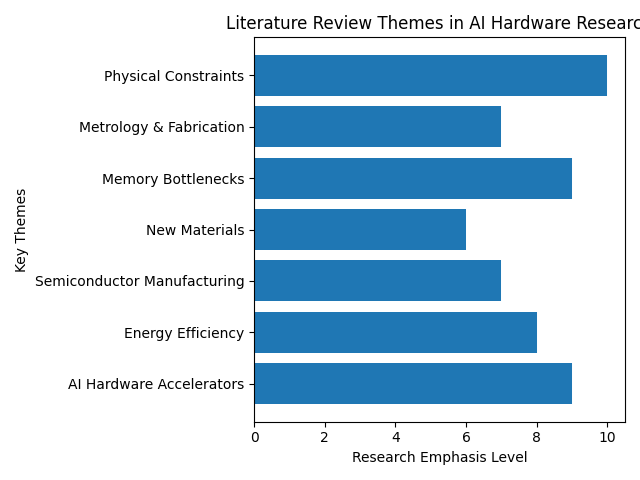
The rapid advancement of artificial intelligence (AI) has been closely linked to the evolution of semiconductor technologies and hardware architectures. Existing literature emphasizes that the efficiency and scalability of AI systems are fundamentally dependent on the design and performance of underlying hardware components. As AI workloads become more complex, researchers have increasingly focused on optimizing semiconductor processes, architectures, and materials to meet growing computational demands.

One of the central themes in the literature is the development of specialized AI hardware accelerators. These architectures are designed to handle parallel processing and large-scale data computations more efficiently than traditional central processing units (CPUs). Hyun et al. (2025) explain that modern AI accelerators integrate optimized data paths and memory hierarchies to enhance performance and reduce latency. Similarly, Wali (2020) highlights the convergence of deep learning algorithms and custom hardware design, emphasizing that co-design approaches are essential for maximizing efficiency in AI systems.

Another significant area of research focuses on energy efficiency and edge computing. With the increasing deployment of AI applications in resource-constrained environments, optimizing power consumption has become a critical priority. Kulkarni (2025) demonstrates that energy-efficient semiconductor hardware is essential for enabling AI inference on edge devices, where computational resources and battery life are limited. This aligns with broader industry trends toward decentralized computing and real-time data processing.

In addition to architectural innovations, semiconductor manufacturing processes have undergone substantial transformation. Raghuwanshi (2024) discusses how artificial intelligence is being integrated into semiconductor design and fabrication, improving precision, yield, and overall efficiency. Similarly, Song et al. (2024) explore AI-driven optimization techniques that enhance chip design by reducing errors and improving performance metrics. These advancements highlight the growing role of AI not only as a consumer of hardware but also as a tool for improving its production.

The limitations of traditional silicon-based technologies have also prompted exploration into alternative materials and novel computing paradigms. Kola (2024) investigates the potential of carbon-based semiconductors in high-performance computing, suggesting that these materials may offer improved electrical properties and scalability compared to conventional silicon. Furthermore, neuromorphic computing has emerged as a promising approach, with Kim et al. (2025) demonstrating how brain-inspired hardware architectures can significantly enhance efficiency and adaptability in AI systems.

Another critical challenge identified in the literature is the issue of data movement and memory bottlenecks. VerWey (2022) argues that the primary limitation in modern AI systems is not computational power but the inefficiency of data transfer between memory and processing units. This has led to increased research into memory-centric architectures and advanced packaging techniques that bring memory closer to computation, thereby reducing latency and energy consumption.

Advancements in semiconductor metrology and fabrication technologies further contribute to the evolution of AI hardware. Xu et al. (2025) highlight the role of AI-powered optical metrology in enabling precise measurement and quality control at the nanoscale. These innovations are crucial for maintaining the reliability and performance of increasingly complex semiconductor devices.

Despite these significant developments, the literature consistently identifies fundamental physical constraints as a limiting factor in AI hardware progression. Issues such as heat generation, electron leakage, and energy inefficiency remain persistent challenges. Boybat (2022) emphasizes that overcoming these barriers will require interdisciplinary approaches that integrate physics, materials science, and engineering.

In summary, the existing body of research demonstrates that while substantial progress has been made in AI hardware development, critical gaps remain. These include the need for more energy-efficient architectures, improved data transfer mechanisms, and scalable solutions that address physical limitations. This study builds on the existing literature by synthesizing these themes and examining how they collectively shape the future of AI hardware systems.
Kartik Jain

  1. Methodology

This study adopts a qualitative and analytical research approach to examine the physical foundations and engineering constraints of artificial intelligence (AI) hardware. The methodology is designed to ensure clarity, consistency, and replicability in analyzing existing knowledge within the field.

3.1 Research Design

The research utilizes a conceptual and descriptive design, focusing on synthesizing existing literature related to semiconductor physics, AI hardware architectures, and engineering innovations. This approach is appropriate as the study does not involve experimental data collection but instead interprets and integrates findings from prior research.

3.2 Data Sources

Data for this study are derived from secondary sources, including:

  • Peer-reviewed academic journals
  • Conference papers
  • Industry reports
  • Technical publications related to AI hardware and semiconductor technologies
  • The selected sources emphasize recent developments (2020–2025) to ensure relevance and accuracy.

3.3 Data Collection Methods

The data collection process involves:

Identifying relevant publications on AI hardware, semiconductor design, and emerging technologies

Extracting key information related to:

  • Transistor design and scaling
  • Memory architecture and data transfer
  • Chip packaging techniques
  • Thermal management systems
  • Photonic communication technologies

3.4 Data Analysis Techniques

A thematic analysis approach is employed to evaluate the collected data. This includes:

Categorizing findings into key themes (e.g., energy efficiency, hardware acceleration, physical constraints)

Comparing different technological approaches and their effectiveness

Identifying patterns, relationships, and research gaps

This method allows for a structured interpretation of complex technical information.

3.5 Reliability and Validity

To ensure reliability and validity:

  • Only credible and peer-reviewed sources are included
  • DOI-referenced articles are prioritized
  • Cross-verification of findings is conducted across multiple sources

3.6 Ethical Considerations

This study adheres to ethical research standards by:

  • Properly citing all referenced works using APA 7th edition
  • Avoiding plagiarism through paraphrasing and synthesis
  • Ensuring accurate representation of original authors’ findings
Component Description
Research Design Qualitative, conceptual, and descriptive analysis
Data Sources Peer-reviewed journals, conference papers, industry reports
Data Collection Extraction of key themes from existing literature
Data Analysis Thematic analysis and comparative evaluation
Reliability & Validity Use of credible sources and cross-verification
Ethical Considerations Proper citation and avoidance of plagiarism
  1. Results

This section presents the findings derived from the thematic analysis of literature on artificial intelligence (AI) hardware and semiconductor technologies. The results are organized according to key themes identified in the methodology.

4.1 Semiconductor Fabrication and Miniaturization

The analysis shows that modern semiconductor fabrication techniques, particularly advanced photolithography, enable the production of nanoscale transistors. However, as feature sizes continue to shrink, physical limitations such as electron scattering and variability increasingly affect manufacturing precision and device reliability.

4.2 Transistor Architecture Advancements

Findings indicate that traditional transistor designs are no longer sufficient for sustaining performance improvements. The adoption of advanced structures, such as Gate-All-Around (GAA) transistors, has significantly improved electrostatic control and reduced leakage currents, enabling continued scaling of semiconductor devices.

4.3 Memory and Data Transfer Bottlenecks

A major result from the analysis is that data movement has become a critical constraint in AI systems. The speed at which data is transferred between memory and processing units limits overall system performance. This has led to the development of high-bandwidth memory (HBM) and 3D-stacked memory architectures.

4.4 Advanced Chip Packaging

The study finds that chip packaging has evolved into a key performance factor. Modern packaging techniques integrate multiple components—such as processors, memory, and accelerators—into a single system. This improves communication speed and reduces latency within AI hardware systems.

4.5 Thermal Management Challenges

Results reveal that heat generation remains one of the most significant challenges in AI hardware. As computational power increases, so does energy consumption, leading to higher thermal output. Conventional cooling methods are becoming insufficient, prompting the adoption of liquid cooling and advanced heat dissipation technologies.

4.6 Emerging Communication Technologies

The analysis highlights the growing importance of silicon photonics as an alternative to traditional electrical interconnects. Optical communication enables faster data transfer with lower energy loss, making it a promising solution for large-scale AI systems and data centers.

4.7 Physical and Theoretical Constraints

Finally, the findings emphasize that fundamental physical laws, particularly those related to thermodynamics, impose limits on computational efficiency. These constraints define the boundaries of how far AI hardware can scale using current technologies.

5. Discussion

The results of this study highlight the critical role of physical and engineering constraints in shaping the development and performance of artificial intelligence (AI) hardware. While advancements in semiconductor technologies and chip architectures have enabled significant improvements in computational power, the findings confirm that these gains are increasingly limited by fundamental physical laws and system-level inefficiencies.

One of the most important insights from this study is that data movement, rather than computation itself, has become the primary bottleneck in AI systems. This aligns with existing research, which emphasizes that inefficiencies in memory access and data transfer significantly impact overall system performance. Despite the development of high-bandwidth and 3D-stacked memory solutions, the growing size of AI models continues to intensify this challenge. As a result, future hardware designs must prioritize memory-centric architectures and improved data locality.

The study also reveals that transistor innovation remains essential but is no longer sufficient on its own. While advanced designs such as Gate-All-Around transistors have improved efficiency and reduced leakage, they do not fully overcome the limitations of nanoscale physics. This supports the broader argument in the literature that the traditional approach of scaling transistor size is reaching its practical limits. Consequently, the focus is shifting toward alternative strategies, including new materials and novel computing paradigms.

Another key discussion point is the increasing importance of system-level integration, particularly through advanced chip packaging. The findings demonstrate that modern AI performance gains are increasingly achieved by integrating multiple components—such as processors, memory, and accelerators—into unified systems. This shift indicates that innovation is moving beyond individual components to the architecture of entire computing systems.

Thermal management emerges as a major constraint with significant implications for scalability. As AI workloads demand more power, heat generation increases proportionally, creating challenges for system stability and efficiency. The adoption of liquid cooling and other advanced cooling techniques reflects the industry’s response to this issue. However, these solutions also introduce additional complexity and cost, raising questions about long-term sustainability.

The emergence of silicon photonics and optical communication technologies represents a promising direction for overcoming data transfer limitations. By replacing traditional electrical interconnects with light-based communication, these technologies offer higher bandwidth and lower energy consumption. This development suggests a future in which AI systems rely on hybrid architectures that combine electronic computation with optical communication.

Importantly, the study underscores the influence of fundamental physical laws, particularly thermodynamics, in defining the limits of AI hardware. These constraints cannot be eliminated but must be managed through innovative design and engineering approaches. This reinforces the need for interdisciplinary collaboration across physics, materials science, and computer engineering.

Despite these insights, the study has several limitations. The reliance on secondary data means that findings are based on existing literature rather than experimental validation. Additionally, the rapidly evolving nature of AI hardware technologies may limit the long-term applicability of some conclusions.

6. Conclusion

This study has examined the physical foundations and engineering constraints that underpin the development of artificial intelligence (AI) hardware. By analyzing key aspects such as semiconductor fabrication, transistor architecture, memory systems, chip packaging, thermal management, and emerging communication technologies, the research highlights the critical role of hardware in enabling modern AI systems.

The findings reveal that while significant progress has been made in improving computational performance, AI hardware is increasingly constrained by fundamental physical limitations. Challenges such as heat generation, energy consumption, data transfer bottlenecks, and the limits of transistor scaling continue to restrict the efficiency and scalability of AI systems. Innovations such as advanced transistor designs, 3D memory architectures, and silicon photonics have provided partial solutions, but they also introduce new complexities.

This study contributes to the field by providing a comprehensive synthesis of how physical laws and engineering practices intersect to shape AI hardware development. It emphasizes that future advancements in AI will depend not only on improvements in algorithms but also on breakthroughs in materials science, system architecture, and energy-efficient design.

For future research, there is a need to explore alternative computing paradigms, such as neuromorphic and quantum computing, as well as novel materials that can overcome the limitations of traditional silicon-based technologies. Additionally, further experimental studies are recommended to validate emerging hardware innovations and assess their practical scalability.

References

  1. Kulkarni, R. C. (2025). Energy-efficient AI inference at the edge: Optimizing semiconductor hardware for small language models. International Journal of AI, Big Data, Computational and Management Studies. https://doi.org/10.63282/3050-9416.IJAIBDCMS-V7I1P132
  2. Kim, Y., Lee, C. W., & Jang, H. W. (2025). Neuromorphic hardware for artificial sensory systems: A review. Journal of Electronic Materials, 54, 3609–3650. https://doi.org/10.1007/s11664-025-11778-x
  3. Xu, W., Zhang, H., Ji, L., & Li, Z. (2025). AI-powered next-generation technology for semiconductor optical metrology: A review. Micromachines, 16(8), 838. https://doi.org/10.3390/mi16080838
  4. Hyun, K. S., Min, P. J., & Won, L. H. (2025). AI hardware accelerators: Architectures and implementation strategies. Journal of Integrated VLSI, Embedded and Computing Technologies, 2(1), 8–19. https://doi.org/10.31838/JIVCT/02.01.02
  5. Raghuwanshi, P. (2024). Revolutionizing semiconductor design and manufacturing with AI. Journal of Knowledge Learning and Science Technology, 3(3), 272–277. https://doi.org/10.60087/jklst.vol3.n3.p.272-277
  6. Song, C., Wu, B., & Zhao, G. (2024). Optimization of semiconductor chip design using artificial intelligence. Journal of Industrial Engineering & Applied Science, 2(4), 73–80. https://doi.org/10.5281/zenodo.12798359
  7. Kola, M. B. (2024). Advancing AI hardware architecture: Performance analysis of carbon-based semiconductors in high-performance computing applications. International Journal of Computer Engineering and Technology, 15(6), 2055–2067. https://doi.org/10.34218/IJCET_15_06_176
  8. Wali, K. (2020). AI-optimized semiconductor architectures: The convergence of deep learning and custom hardware design. International Journal of Innovative Research in Engineering & Multidisciplinary Physical Sciences, 8(4). https://doi.org/10.37082/IJIRMPS.v8.i4.232593
  9. VerWey, J. P. (2022). The other artificial intelligence hardware problem. Computer, 55(1), 34–42. https://doi.org/10.1109/MC.2021.3113271
  10. Boybat, I. (2022). Editorial: Hardware for artificial intelligence. Frontiers in Neuroscience, 16. https://doi.org/10.3389/fnins.2022.979495




Why Dino Rizzo Says the Best Leaders Show Up and Encourage Others

Leadership is sometimes associated with strategy, vision, and decision-making. While these elements matter, another quality plays a critical role in shaping healthy teams and communities: presence. Leadership is not just about directing people toward a goal; it is about showing up with consistency, offering encouragement, and creating an environment where others feel supported as they grow.

Dino Rizzo emphasizes a leadership approach built on intentional presence. This means paying attention to the people behind the work—recognizing their effort, encouraging their progress, and helping them navigate both challenges and success.

When leaders remain present and engaged, they influence more than outcomes. They shape culture.

Why Presence Matters in Leadership

People rarely remember every strategy or meeting that shaped a project, but they remember how they were treated along the way. Leaders who remain present build trust because their support extends beyond performance or results, and ultimately keep the teachings of Jesus at the forefront of their mission.

Intentional presence means noticing what is happening around you. It includes listening to concerns, acknowledging effort, and recognizing moments when encouragement can help someone regain confidence.

When leaders remain accessible and attentive, they strengthen relationships that make long-term collaboration possible.

Dino Rizzo Teaches That Encouragement Builds Stronger Teams

Encouragement is not limited to celebrating major achievements. It also includes recognizing steady progress, resilience, and the small steps that move a team forward.

Leaders who encourage their teams consistently create a culture and community where people feel valued rather than overlooked. This kind of environment motivates individuals to contribute more fully and to support one another.

A simple word of encouragement at the right moment can renew someone’s energy and restore their focus on the work ahead.

Presence Creates a Culture of Support

Culture forms through repeated actions. When leaders show up with patience, attention, and encouragement, those values begin to shape the entire group.

Teams start to mirror the same behaviors. People become more willing to support one another, share ideas, and step forward during difficult moments.

Presence from leadership does more than guide the direction of a project. It influences how people treat one another throughout the process.

Encouragement During Difficult Seasons

Leadership becomes most visible when circumstances grow difficult. Pressure, setbacks, and uncertainty can affect morale and motivation.

Dino Rizzo says that during these moments, encouragement and presence become even more important. A leader who remains engaged during challenging seasons reinforces stability and reminds people that their effort still matters.

This kind of leadership helps individuals maintain perspective and continue moving forward when progress feels slow.

Why Intentional Leadership Matters

Intentional leadership recognizes that people thrive when they feel supported and valued. While goals and performance remain important, the way leaders interact with their teams shapes long-term success.

Encouragement strengthens confidence, and presence builds trust. Together, they create an environment where people feel safe to grow, contribute, and develop their potential.

When leaders focus on both people and purpose, they strengthen the foundation for meaningful and sustainable progress.

Why Presence and Encouragement Matter

Leadership is more than directing progress or achieving results. It is also about the way leaders show up for the people around them.

Intentional presence and consistent encouragement shape stronger teams, healthier cultures, and more resilient communities. When leaders invest attention in people—not just outcomes—they create environments where individuals can grow and succeed together.

The most influential leaders are not defined solely by the goals they achieve, but by the people they strengthen along the way.

About Dino Rizzo

Dino Rizzo is a pastor and ministry leader with more than 35 years of experience. He is the co-founder of the Association of Related Churches (ARC), a network that has helped launch hundreds of churches worldwide. Rizzo is also the founder of the Servolution movement, which encourages people to serve their communities through practical acts of kindness, and he is the author of books including Servolution and Serve Your City.


Why Hiring a Professional Moving Company Makes All the Difference

Moving sounds simple until you’re in the middle of it. Packing, lifting, organizing, coordinating timelines. It adds up fast. That’s where a professional moving company changes everything. You’re not just paying for transport. You’re paying for efficiency, protection, and peace of mind.

Experience That Saves Time and Stress

Professional movers do this every day. They know how to pack fragile items, handle bulky furniture, and load a truck so nothing shifts during transit. What might take you a full weekend can often be done in a few hours with a trained crew.

They also come prepared. Proper equipment, packing materials, and a clear process. No last-minute runs for boxes or tape. No guesswork.

Protecting What Matters

Your belongings aren’t just “stuff.” Some items are expensive. Others are irreplaceable. Professional movers understand that.

They use proven packing techniques and protective materials to reduce the risk of damage. Most reputable companies also offer insurance options, so you’re covered if something unexpected happens. That alone gives many people peace of mind during a move.

Efficiency You Can’t Replicate Alone

A well-organized moving team works like a system. One group packs, another loads, another manages logistics. That coordination keeps everything moving smoothly.

Trying to replicate that with friends or family usually leads to delays, confusion, and a lot of heavy lifting without a clear plan.

Why Hiring a Professional Moving Company Makes All the Difference

Avoiding Hidden Costs

At first glance, a DIY move looks cheaper. Rent a truck, grab some boxes, call a few friends. But the costs add up quickly. Fuel, equipment rental, packing supplies, potential damage, and even time off work.

Professional movers provide a clear quote upfront. You know what you’re paying for, and you avoid unexpected expenses along the way.

Safety First

Lifting heavy furniture and navigating tight spaces comes with risk. Injuries during moves are more common than people think.

Professional movers are trained in proper lifting techniques and safety practices. They know how to move large items without damaging walls, floors, or themselves. That reduces risk for everyone involved.

Flexible Services to Match Your Needs

Not every move is the same. Some people want full-service packing and unpacking. Others just need help with loading and transportation.

Most moving companies offer flexible options. You can choose the level of support that fits your budget and timeline. That flexibility makes professional help accessible, even for smaller moves.

Final Thoughts

A move is a major life event. It doesn’t have to be overwhelming. Hiring a professional moving company in Vancouver brings structure, speed, and reliability to the process.

Instead of worrying about logistics, you can focus on settling into your new space. And that’s the part that actually matters.