All too often we overlook some of the truly miraculous advancements we’ve been able to make in the medical space – some of the most incredible developments have come from developments in audiology and ophthalmology. Even casting the shades back 100 years will surprise a great many of us, before the advent of microchips and more stable wiring, there wasn’t a whole lot that could be done for those who were dealing with ailments that impacted these all-important senses.
Those with hearing impairments are seeing an incredible amount of innovation and research go into the alleviation and treatment of a variety of causes and resulting debilitations. Thankfully, as technology has progressed so rapidly, we’ve seen the quickened development of devices like rechargeable hearing aids that offer convenience, comfort, and subtlety.
For this article, we will be focusing on the incredible road that audiological technology has undertaken and see what could be around the corner for those in the future.
The 3 Types Of Hearing Loss
Let’s first understand the notion of hearing loss and explore the common associations of hearing loss that exist in the zeitgeist would require medical intervention of rechargeable hearing aids.
Conductive
Often associated with sound transportation issues that are often mechanically inclined in the audible processes. Essentially conductive refers to issues or difficulties sound has travelling through the ear canal, eardrums, bones etc. This could be caused by excess ear wax, holes in the eardrums, fluid buildup, even leftover cotton from ear buds being stuck.
Sensorineural
The more common associative hearing loss demarcation is sensorineural. Nerve damage, natural aging, traumatic/excessive vibration damage, head injuries etc., can all cause irreparable damage that cannot be reversed. However, this is where the technological notion comes in to assist, as devices like cochlear implants and rechargeable hearing aids can amplify and improve the quality of life for those with this type of hearing loss.
Mixed
Mixed is essentially a combination of the previous two associations. The cause and treatment of which will vary wildly case by case.
The Technological Breakthroughs
The humble hearing aid truly is a miraculous device. The design itself has not changed so much since its inception decades ago, with most models of rechargeable hearing aid housing 4 key components: microphone, processor, power supply, and receiver.
As sound is received by the microphone it is collated through the processor, signaled into the receiver which transmits the data directly into the ear canal. As time has progressed, the power supply has been updated, the microphones have become more nuanced and discerning, and the receivers and processors have seen tremendous updates to their efficiency and efficacy in delivering more stable information.
Cochlear implants are a little different to rechargeable hearing aids in that there is a more permanent surgery involved that is more suited to those with profound auditory loss. It stimulates the auditory centre of the brain to elicit the sensation of sound mechanically.
The Future
One can only look to the future with a sense of optimism and hope. As the technology improves in rechargeable hearing aids to make them last longer and become more sensitive and individualised for each user, the common ailments of yesteryear will soon remain in the past. News of the Neuralink becoming more safe for consumer use in the next decade is also a silver lining to a horrendous start to the decade, and a renewed hope for auditory sufferers everywhere.
For now, those with slight to profound levels of auditory loss have cochlear implants or rechargeable hearing aids to choose from that will assuredly keep them living day-to-day.
Some people are overwhelmed by the idea of how to create eLearning content, but you don’t have to be. Here, eLearning Partners, a Denver-based company specializing in eLearning, gathered the five best types of eLearning content that are simple to make. Use them alone or combine the various types of eLearning content in a way that works for your course.
#5. Action-based Workbooks
Workbooks have been a staple of education for centuries because they work well. As a bonus, they are incredibly easy for you to make. However, the key is that you don’t want to make a workbook just for the sake of creating a workbook. The fact that it is action-based is crucial here.
The action-based aspect of the workbook means that it needs to serve a purpose and create value. For example, we have a workbook that you go through and map out the process of producing a course. Then, once you finish it, it becomes a blueprint and management system as you create the course.
As mentioned, workbooks are incredibly simple to make. You can make them in Google Docs or Google Sheets for free. If you have a Microsoft license, you can make them in Excel or Word.
#4. Audio
Audio is an ideal type of eLearning content because it lets you appeal to a wider range of learners. Many people listen to podcasts and audiobooks and creating an audio-based course lets you take advantage of this. With an audio course, you give learners the freedom to multitask while learning. Maybe they will listen on their daily commute or while exercising.
On top of that, making an audio lesson is very straightforward. If you already have a video you want to turn into an audio file, save it as audio in your computer’s settings. Or you can create content from scratch with your phone’s audio recording feature. The only caveat is that you need to ensure your audio sounds clear.
#3. Lightboard
Lightboard would be number one on our list of simple types of eLearning content if not for the cost. Unfortunately, the tech for Lightboard may eat into your budget. But the good news is that many public libraries have Lightboards that they let patrons use. If your library has one, you should consider this method of how to create eLearning content. Even if it doesn’t, you may want to consider it.
The great thing about Lightboard is that it was specifically designed for recorded lessons. You write, and viewers can see the content you write. Just remember that Lightboard will record your writing backward, so you have to flip the video at the end (or learn to write backward).
#2. Interactive Video
Many of the best types of eLearning content are interactive, which is why interactive video is such a great option. It may seem complex, but with the right software, it is very easy. On top of that, there are free programs like VideoAsk.com that let you create this type of content.
VideoAsk was created to get feedback and customer testimonials, but it is very easily adaptable into an eLearning course. Use it to create questions that your learners will interact with. From there, you interact back with them to provide feedback.
#1. Screen Capture Software
While screen capture software won’t work for all types of eLearning courses, it is among the most versatile methods of how to create eLearning software. You can use it to go through the workbook you created or a PowerPoint that you make for your learners. You can use it to show how-to processes, such as using software or searching for something. There are free options as well as paid options available. We suggest Loom.com, which we use.
Conclusion
Creating an eLearning course does not need to be overly technical. There are some great types of eLearning content that you can make with minimal effort or investment. From screen capture software to workbooks to audio, you need to decide which one works best for your learners and goals.
About eLearning Partners
eLearning Partners — formerly known as VP Legacies — is a company specializing in eLearning. Our clients range from small to mid-sized organizations that are looking to develop & launch their eLearning products — online courses, employee training, and entire Internal Universities. Over the last eight years, we’ve successfully deployed eLearning products 7x faster than the industry average with an 80% learner engagement — all due to our exceptional focus on the Learners and their needs.
Summer is fast approaching, and no doubt there are a number of people are calling up services like Party Shakers to book in a bespoke bartending experience like no other. While the world has opened back up, there seems to be a rising tide of people who are preferring to keep it classy and personal. House parties and occasions are becoming more popular than going out, and with services like Party Shakers, it is not hard to see why.
Keeping It Simple
Planning a party or event these days is arduous enough, especially when you consider the restrictions and down-payments you need to make for any given venue. Then, on the night of, there can be any number of issues, from slow service to loud table neighbors that throw a spanner into your special evening.
These private bartending services are changing the way we look at hospitality, think of it as the best of the best from the industry coming right to your door and setting up shop. As you can see, it really is quite simple, and the burden of responsibility is immediately lifted once you’ve made the call. No more lines at the club, no more worrying about noise levels, and no worry about cleaning up.
The Party Shakers Experience
Party Shakers have made a name for themselves in recent years as the premier choice for private events. Not only do they have the requisite skillset you want in bartenders, but they also make their mark with the little additions to their service that no other enterprise offers at such an affordable price.
The house party is back in fashion, and Party Shakers is there to serve. Their uniqueness is bolstered with a personalized setup that can fit into almost any theme you can imagine. Their theme is Luxuriously Affordability – all the bells and whistles without the price tags. This comes out in spades when you see some of their previous setups which includes photobooths and wild range of cocktails.
…With A Smile
Too many bartending services neglect the most important aspect of hospitality, service! This was once of the principal reasons for the creation of the company as their founders wanted to offer a signature style and undeniable service for their ever-growing list of clients.
Their easy customer service and obvious experience in the realm of hospitality allows them to stand head and shoulders above the rest. Their ambition is quite inspiring as well as they’re planning on expanding to even more states around the USA to give more parties a little shake up.
Their range is continuously expanding as well with more options for every budget range and style of party you can imagine.
Investment property is purchased with the intention of earning a return on investment through rental income or future sale of the property.
A long-term or short-term investment can be made in an investment property. Investors frequently participate in flipping, which is purchasing real estate, remodeling or renovating it, and then selling it for a profit in a short period of time. According to Joseph Blake Smith, CEO of Rock Capital Group, buying an investment property can be a great tool to generate the best ROI.
Investors will occasionally do research to find the best and most profitable use of a property. This is referred to as the property’s best use. If an investment property is zoned for both commercial and residential use, the investor considers the benefits and drawbacks of each to determine which offers the best potential rate of return. They then make use of the property in that way.
Investment properties types:
You can find 3 types when it comes to investment property.
Number 1 Residential: Investing in rental properties is a common option for people to augment their income. Monthly rents can be collected by the person who buys a property to rent out to tenants. Apartments, family homes, condominiums, townhomes, and other forms of house structures are all examples of this.
Commercial: Income-producing properties aren’t residential properties all of the time. Some investors, particularly businesses, buy them for commercial reasons and utilize them exclusively for business. These properties may require more maintenance and renovations, but the greater expenses can be mitigated by higher returns. This is due to the fact that these properties attract big rents frequently. These structures could be commercially operated residential complexes or retail storefronts.
Mixed-Use of Property: A mixed-use investment property is used by both businesses and individuals at the same time like a building can have a retail store or offices on the main floor and the upper section of the building could have residential floors.
Finance an investment property
Borrowers who receive loan to buy permanent residents can take advantage of a variety of financing alternatives, including FHA, VA, and conventional loans; but, obtaining finance for an investment property might be more difficult.
Because mortgage insurance is not available for investment homes, borrowers must put down at least 20% to qualify for bank financing. Before qualifying a borrower for an investment property mortgage, banks want high credit ratings and low loan-to-value ratios. Some lenders also demand the borrower to have sufficient savings to cover at least six months’ worth of investment property expenses.
SS Global Entertainment is creating a lane for independent creators to be able to not only learn the ropes to what it takes to grow within a competitive industry, but also teaches strategies on how to ensure they are earning. Tiffany Gaines, 41-year-old founder and CEO of SS Global Entertainment, is making headway in the digital space of music and is standing strong as an advocate for musicians.
For the last decade, SS Global Entertainment has been signing artists and independent labels to its distribution network. While most distributors restrict artists and labels with three – and five-year deals, SS Global offers non – exclusive agreements with incentives and resources through their marketing and PR firm, SS Global Media. Furthermore, the company offers lifetime access without any annual or additional fees associated.
SS Global, which distributes and consults for over 65 record labels, including Amada Records, Freeway Rick Ross Music Group, Hood and Associates, all of which have distributed acts such as Chris Brown, Lauryn Hill, Wyclef Jean, Missy Elliot, E40, Moneybagg Yo, Kurupt of Tha Dogg Pound, just to name a few and since its conception has sparked revenues by several tens of millions of dollars to date.
Their business model and company motto is living proof that they have and will continue to thrive as a company set to impact the independent scene exponentially.
Follow the company on its social media profiles below.
The biggest struggle for each developing company is to make money and keep the most margin profit. As a company becomes bigger, it is hard to reduce the extra cost especially when the company is following a traditional managing and manufacturing system. With a brief look at the market cap, it is highly understandable that most money maker businesses are the most digitialized ones. On the other hand, traditional and old fashioned companies are getting faded one by one.
Consider a UPS manufacturing company with only 30 employees, in ten years of working, they have designed and manufactured more than 900 devices for different industries and clients. But they are facing some problems such as:
It is easy to accept the orders but it’s not to buy all the materials and components in the right time and finish the manufacturing without any delays.
In this company there are minimum human resources for after sales services and as each device is installed in different places around the country, they face many issues with managing the after sales service schedule.
Also using outside technicians might damage the quality of work, hiring more engineers and training them is a good idea but that would cause financial burdens.
Sometimes a customer from one of the southern areas calls and needs a simple check of settings or they have a simple alarm that can be easily solved. Sending a team there can be expensive for the company specially when the customer is using their guarantee period.
Let’s get digitalized
Companies’ managers know that with digital transformation, these types of situations can be solved,
IoT consultants after analyzing every aspect of the business will share the ideas of how to become a digital master.
Here are some examples:
1. IoT virtual assistant (for customer service)
One of the strategies to reduce customer services can be implementing an IoT assistant for the devices. Each device has a local monitoring system that saves the log of alarms. With IoT, it is possible to design a virtual assistant so if the customer connects their devices to the Internet in their site, they can monitor their alarms. Also the technicians of the factory can be connected remotely and change the settings or decide what to do with each alarm.
2. Guarantee Control
Sometimes it is hard for the company to understand that operators have misused the device and they service and repair the problem without any cost. With IoT it is possible to control the misuse and disable the guarantee period of that device.
3. Digital portal for customers
As it is hard to supply all the components in a proper time, with creating a digital portal for customers it would be possible to schedule next orders and pursue customers to order sooner.
4. Temperature
As these devices are very sensitive to temperature and humidity, it is possible to implement IoT gateways to sense and collect data and warn the user if they are damaging the device.
5. Smart Updates
With developing technologies there might be software updates which are hard to implement to all the sold devices and update them, but with IoT it is possible to access remotely and update them.
Conclusion
The future of business is digitalization and implementation of IoT platforms, starting this journey sooner would accelerate our businesses and keep us alive in the market.
Generally, when we talk about GPS, it is thought to be a map application on a smart device, such as mobile phones, vehicles, or GPS devices. This shows a destination point, distance, and time to reach the point.
GPS is an abbreviation of Global Positioning System, which is a set of three different components:
Space, Ground control, User equipment
Space consists of Satellites that orbit the Earth and transmit radio signals to GPS receivers.
Ground control is made up of Earth-based monitor stations, master control stations, and ground antennas. Ground Control’s job is tracking and operating the satellites in space and monitoring transmissions. There are monitoring stations on almost every continent in the world, including North and South America, Africa, Europe, Asia, and Australia.
User equipment or GPS receivers including all devices on the earth which are equipped with GPS such as watches, vehicles, smartphones, and telematics devices.
The most popular and commonly used navigational satellite systems in the United States are NAVSTAR or GPS. In addition to the United States, there are several countries like Russia (GLONASS), India (IRNSS), China (BeiDou), and Europe (GALILEO) for example, who have their navigational satellite systems as well. The systems belonging to China and India are not worldwide systems because they are revolving in a geosynchronous orbit above their countries.
In this passage, we will discuss the functions of the NAVSTAR systems, simply referred to as GPS. It is also quite common for most phones and devices to have futures of both GPS and GLONASS as navigation systems.
The first time that the U.S. Department of Defense put the satellites to use was only for military purposes. Soon after, they were made available for civilian use in the 1980s.
The GPS Satellite System specification
The GPS consists of 31 satellites orbiting the Earth; 24 of them are core satellites and the rest are spare and serve as emergency replacements when something happens to others. The Satellites need constant maintenance and sometimes some repairs. After all, they only last about 10 years.
These 24 satellites are circling on orbital planes of a constellation with a constant distance of 20,000 km from the earth and with a speed of 14,000 km/h.
The satellite’s main power supply is provided by solar energy and they also have backup batteries onboard that can be used in case of a solar eclipse.
GPS satellites constellation orbital planes
Ground control
The GPS Ground control is the global ground station on earth that tracks the GPS satellites, monitors their transmissions, performs analyses, and sends commands and data to the constellation. These stations are located on all continents.
How does GPS work?
GPS satellites circle the Earth twice a day in a precise orbit. Each satellite constantly transmits a unique radio signal with orbital parameters and extremely accurate timestamp (obtained through atomic clock on-board the satellites), that allow GPS devices to decode and compute the precise location of the satellite.
In GPS positioning systems two basic scientific concepts are used: trilateration (not triangulation) and
Distance ( = Speed * time). As we know, the speed of a radio signal is light speed.
2-D or 3-D Trilateration is a method that can determine the position by knowing the distance from 2 or 3 Geographical coordinates.
As is mentioned, the radio signal which is sent from the satellite to the GPS receiver provides two important pieces of information such as the instantaneous, the exact time of signal transmission, and the orbital coordinates of the satellite.
The GPS receiver uses the above relationship to calculate the distance to each satellite. Knowing the distances of at least three satellites will allow us to determine the position of GPS receivers on Earth.
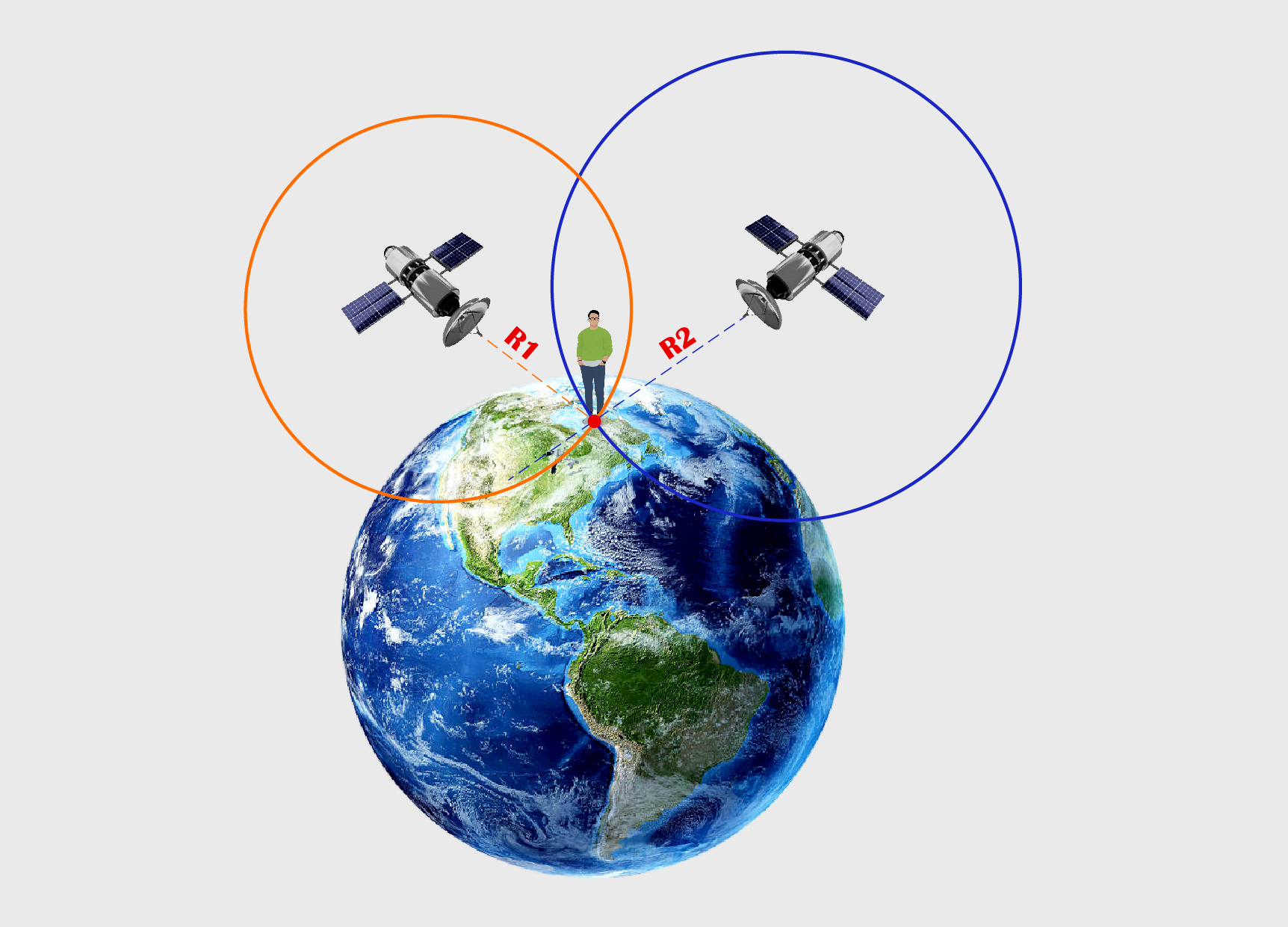
First, let’s explain three-sided surveying in two dimensions (2D three-sided surveying). The distance from the first satellite of the GPS receiver is R1 and the distance from the second satellite is R2. Imagine two circles with the first and second satellites in the center and radii R1 and R2.
Being on the surface of the earth, the position of the GPS receiver is the intersection. This considers the earth as the intersection with the third circle. If you put the three circles together, they will be in the same place as the GPS receiver.
2D three-range surveying is the calculation of latitude and longitude positions on a map.
In 3-D trilateration, it’s the same, but there’ll be spheres instead of circles. 3-D position includes latitude, longitude, and altitude geographical coordinates. In the three-dimensional world, instead of two satellites, we need three satellite measurements.
In the three-dimensional world, the intersection point of three spheres gives two points. Just like in the previous case, using the Earth as the fourth surface we find the correct point in the below picture.
Let’s consider two important complex issues here:
The time in the GPS satellite is based on the precise time of atomic clocks that exist on them, while the receivers have regular quartz clocks. This Time difference will cause a huge error in GPS calculations. Having information from the fourth satellite solved this error. Therefore for calculating the location and time of a GPS receiver we need four satellites’ radio signal information.
Einstein’s general theory of relativity
Another complication is based on Einstein’s general theory of relativity; In space far from gravity, the time of the motion for an object is faster than that for an object on the ground.
At an altitude of 20,000 kilometers above the Earth, the satellites experience one-quarter of the Earth’s gravity, thus, according to Einstein’s general relativity theory, the clock should accelerate by about 45 microseconds per day. This causes 38 microseconds to offset every day in the atomic clock.
To compensate for this, a theory of relativity equation is integrated into the computer chips and adjusts the rates of the atomic clocks. Without this application of the theory of relativity, the GPS would have produced an error of 10 kilometers every day.
Precise timekeeping
GPS satellites have atomic clocks that keep the most precise time, but it would be impossible to install these clocks in every receiver. Satellites’ atomic clocks get 38 microseconds ahead of ground clocks every day.
GPS not only determines the most precise location of people and things but also sends a time signal accurate to less than 10 billionths of a second. Power grids, banking systems, and mobile networks all use GPS for precisely timestamped transactions to operations from synchronized call transfers.
Uses of GPS
Global Positioning System GPS is a powerful and dependable tool for businesses and organizations in many different industries.
Surveyors, scientists, pilots, boat captains, first responders, and workers in mining and agriculture are just some of the people who use GPS daily for work. They use GPS information for preparing accurate surveys and maps, taking precise time measurements, tracking position or location, and navigation. GPS works at all times and in almost all-weather conditions.
There are five main uses of GPS:
Location — Determining a position like a car locator,
Navigation — Getting from one location to another.
GPS Tracking — Monitoring object, pet, School Bus Tracking, Trailer Tracking, or personal movement.
Mapping — Creating maps of the world.
Timing — Making it possible to make precise time measurements.
But GPS can also be really useful for scientists and not just in ways you might expect, like by helping them track animals. Scientists can also use GPS to help predict how bad a tsunami might be, to warn people about flash floods, or measure how dry a forest gets during a drought all by taking advantage of two basic ideas.
GPS doesn’t requireaninternet connection.
GPS does not require internet or cell phone signal. However, with their help, the GPS launch can be significantly accelerated. Satellite location information can be downloaded from the Internet, rather than downloading it directly via satellite, which is very slow. Such GPS systems are called assisted GPS.
So, the next time you track your food delivery or navigate your car, please keep in mind how important the theory of relativity, developed by Einstein, and the other mathematical ideas are behind GPS.
Access to essential medications is the ultimate dream of every individual. But why do millions of people across the globe lack access to the treatment they need? The reason is no other than increased price and lack of availability of these essential medicines to those who need them. As the world is hit with a high price increase on health products, it was estimated that one-third of the global population lack access to essential medications. Online pharmacies are one way to alleviate this issue; they offer competitive pricing while providing the same products at lesser prices.
Why does purchasing prescription drugs online cost less?
During the pandemic, most pharmaceutical companies have raised the prices of most of their products by about 10%. This is why many people switched to online pharmacies. Below are the major reasons online pharmacies remain the best option for getting quality drugs at affordable prices.
Competitive prices
Most online pharmacies offer highly competitive pricing for essential drugs. Some of them offer search tools that allow people to compare the cost of drugs from other online pharmacies and identify the price that best suits them. It’s okay to ask the online pharmacy for their pricing before filling your prescription. This may help cut costs, especially if you will be refilling the prescription regularly.
Home delivery
The home delivery system is one of the major reasons why online pharmacies have an edge over traditional pharmacies. It’s a safe, convenient, and effective way to get your prescription drugs regularly. Canada Pharmacy offers a cost-effective standard delivery in weather-resistant packaging. This makes it easier to deliver your prescriptions when needed.
Coupons
Most online pharmacies offer coupon discounts. However, only limited coupons are offered for brand-name drugs. Customers would have to meet certain criteria to be eligible for these coupons. In addition, some online pharmacies also offer other incentives to encourage customers to patronize them.
Generic drugs
After a certain period, a brand-name drug loses its patent right, and its formula drug becomes available for generic use. Other labs can now use this formula to produce this drug containing the same active ingredients. Customers can receive the same prescription as the brand-name drug but at a much lesser cost. You can ask for generic drugs as a substitute for brand-name drugs from these online pharmacies. However, you should always read the label on generic medications for any additional ingredients that could affect your system.
Patient Assistance Programs
Virtually every online pharmacy has a patient assistance program. This helps cut costs by making drugs much more affordable. Every online pharmacy has its set of standards for the patient assistance program. You can check that on their website.
Conclusion
Each year, the prices of prescription drugs go up, and that seems like a new normal. This trend forced people to look for other alternatives – and this gave birth to online pharmacies. Online pharmacies are a great way to deal with the hike in prices of prescription drugs. You can get good-quality prescription drugs from these online pharmacies at highly reduced prices.
The internet has become a vital tool globally for plenty of us in day-to-day life. We online shop, order food, book travels, and share content with our friends and family on social platforms. Yet many of us never stop to think about how all of this is made possible.
What does API really mean?
How do applications get access to databases? How do they present the right information we seek with our gadgets?
You may have come across the acronym API. Now, it may seem like a complicated phrase or form of technology, but what does API really mean?
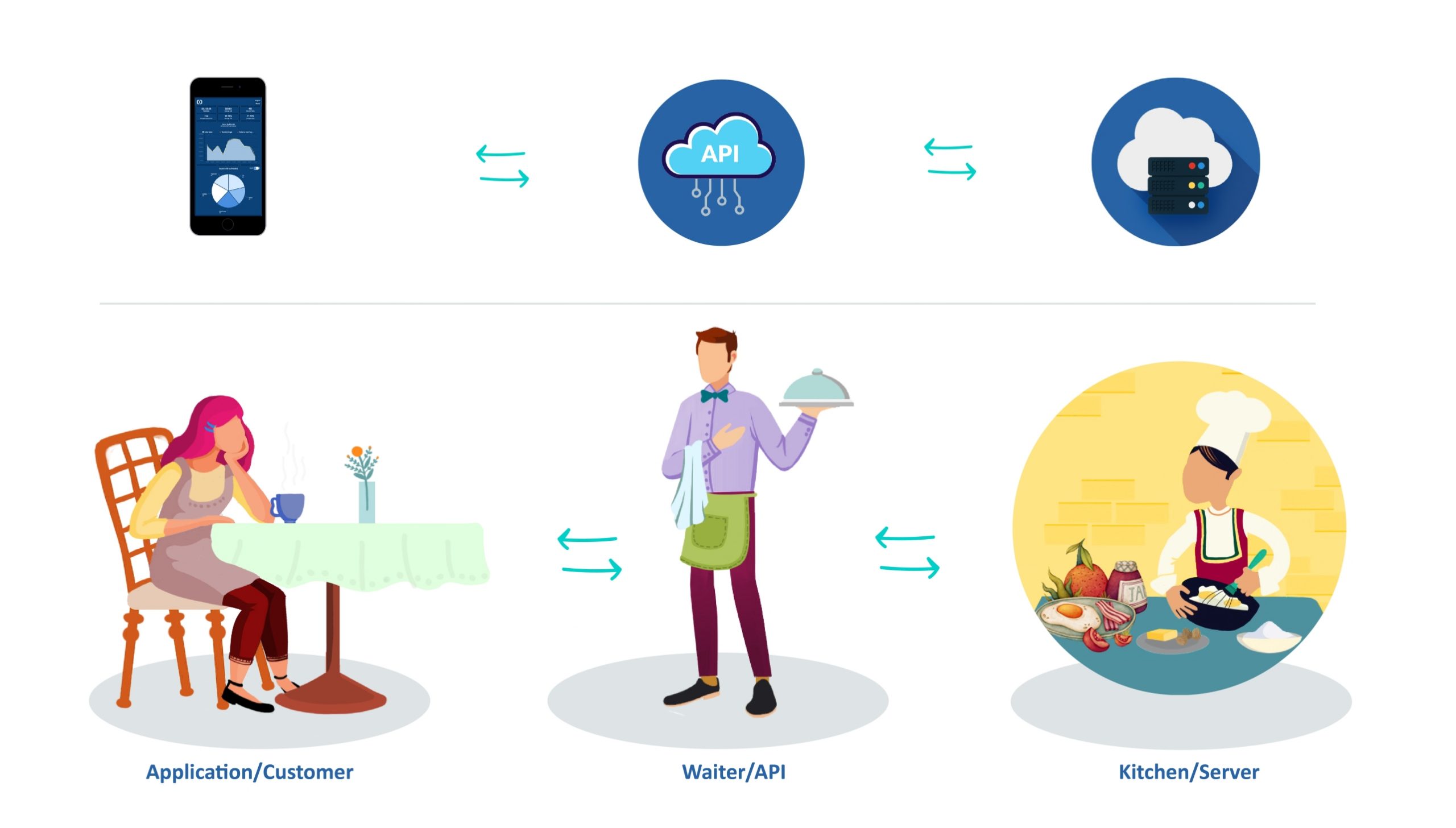
API or “Application Programming Interface” works as a messenger between the provider and us. (Further explain who “us” is). API receives requests and delivers it to the provider and then back to us with a response.
Picture this analogy. API acts as the waiter in a restaurant, with the kitchen acting as the provider. The waiter takes the order, which he delivers to the kitchen. The kitchen then prepares the order, and comes back to us with food which is a response to the initial response. In fact, you don’t know exactly how the restaurant prepares that food, which is fine because you don’t need to. This is exactly how API works.
From a technical view, API is a program of instructions that is a standard to access a web-based software application or service.
API is what makes communication between applications and providers possible.
Some API examples:
How are we able to check the weather with our devices so easily and accurately? How are we provided exact data based on our requirements? There are many weather stations globally, which are able to, using API technology, acts as an interface between Apps and millions of endpoints around the world. These apps take our requests to providers, obtaining the exact data from available databases and right back to us.
Another example is trip booking. There are many different factors involved in booking vacations including things like airfare tickets, hotels, etc… We are able to run apps on our mobile devices and select the time, destination and send it through the internet. API takes in these requests, then runs them through different databases to find information on flights, hotels and anything else we may need to know about our desired destination. With all this information at our disposal, we can decide and select a suitable offer. Before API and integrated applications, all this had to be done over the phone!
In terms of publishing policies, APIs can divide 4 types:
Open or Public API: Public APIs are open and available to be used by any outside developer or business with minimal restrictions.
For instance, Facebook’s open API has made it possible to create an account on an external site/app using your Facebook credentials. Google Maps is another example of an open API that can be used in Internet Taxi or other video games in need of dynamic, live-time maps.
Partner API: A partner API, is only available to specifically selected and authorized outside developers or API consumers. These is are used to facilitate business-to-business activities
Partner APIs are similar to open APIs but with some restrictions implemented by business partners.
They are used for specific purposes, such as providing access to a paid-services.
Private or Internal API: Private APIs are provided to developers for in-house personnel to increase productivity as well as better communication of computer systems. They are used within companies to share resources.
Web developers in organizations may use these APIs to integrate corporate IT systems or applications. Using internal APIs has several advantages including security as well as access control of the system.
For example, interactions between different parts of a company like the HR and finance department is possible by internal API.
Composite API: Composite API is as the name implies, which is a combination of two or more APIs to generate specific information for specific requests.
In some cases, one API couldn’t generate all of the required information so we need a combination between some APIs.
Travel booking is an example of a composite API that uses data from several databases (Transportation system data that includes airway, train, bus, hotel reservations, climate information to check the weather in destinations to manage the trip program).
API Protocols and Architectures:
The purpose of API protocol is to standardize data exchange between web services.
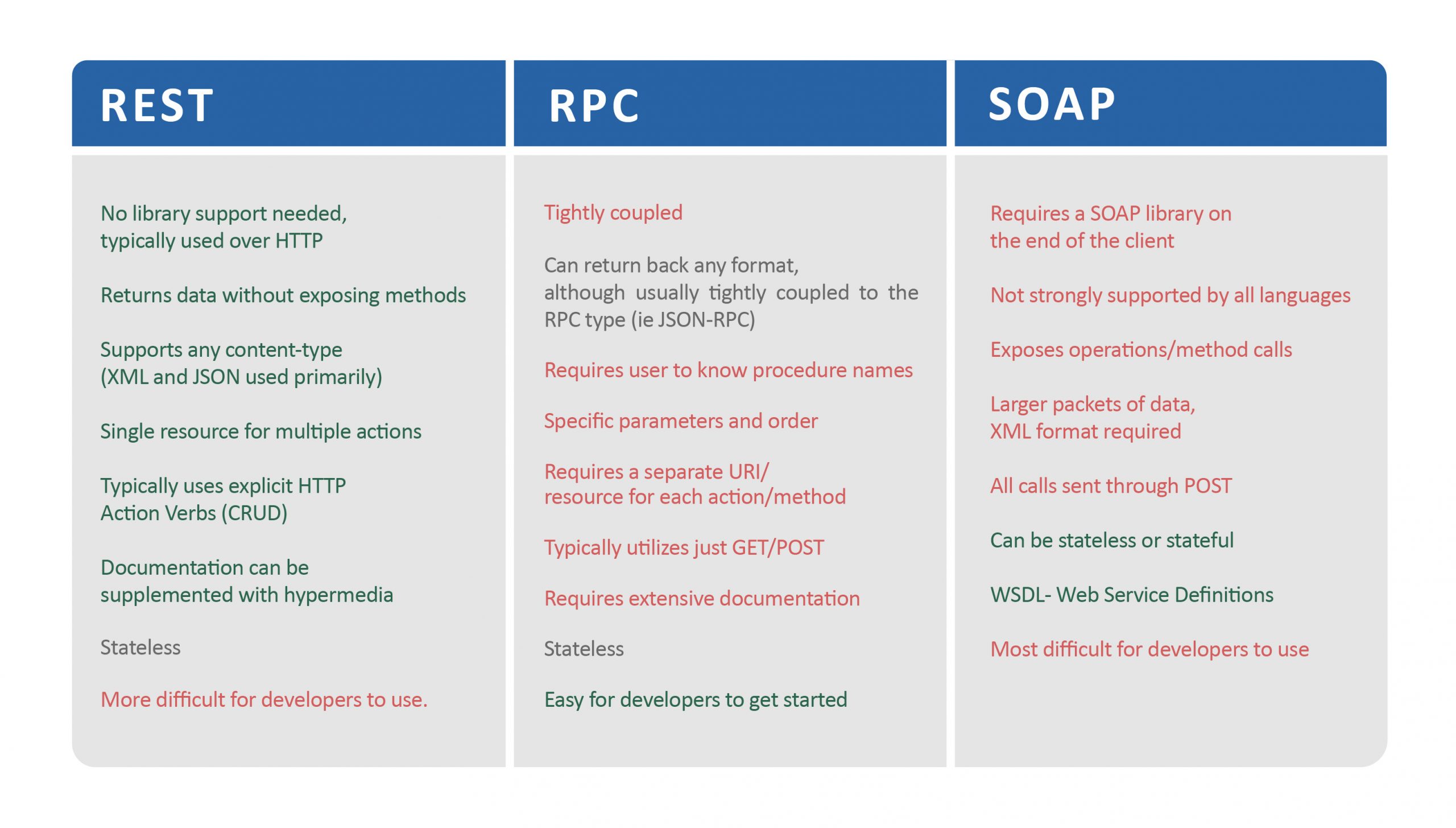
There are different types of API protocols, but we will review 3 main types of them; REST, SOAP and RPC.
REST (Representational State Transfer) is the most popular approach to API protocols.
REST responds to a client/server approach that separates the front and back ends of the API, and provides significant flexibility in development and implementation. REST is a “stateless approach,” which means the API saves no data between inquiries. REST supports caching, which stores responses for slow or non-time-sensitive APIs. REST APIs, usually called “REST-ful APIs,” also can communicate directly or operate through intermediate systems such as API gateways and load balancers.
RPC (Remote Procedure Call) protocol is a simple way to send multiple parameters and receive results. RPC APIs include executable actions or processes, while REST APIs mainly exchange data or resources such as documents. RPC can incorporate two different languages, JSON and XML, for coding; these APIs are dubbed JSON-RPC and XML-RPC, respectively.
SOAP (Simple Object Access Protocol) is mostly used with enterprise web-based software to ensure high security of transmitted data. SOAP is a messaging standard defined by the World Wide Web Consortium and used broadly to create web APIs, usually with XML formats. SOAP supports a wide range of communication protocols found across the internet, such as HTTP, SMTP and TCP. SOAP is also extensible and style-independent, which allows developers to write SOAP APIs in varied ways besides affixing features while functioning easily. The SOAP approach defines how the SOAP message is processed, determines the features and modules included, and decides the communication protocol(s) supported and the construction of SOAP messages.
There are situations where you need to develop your own custom API to provide all specific requirements, in this case we call it Custom API which can be developed by companies who are specialized in Firmware Developments and understand the low level code down to electronic chips.
Conclusion:
API is an alternative to the user interface. Just as users can send a command to hardware or send a message to software by just a click of a button, API is a tool that allows applications and providers to communicate with each other, sending and receiving commands.
APIs are everywhere and without them, collaboration between small components of hardware and software systems would not be possible.
APIs are behind the scenes of all applications, although we cannot see them, but every time we run an application, we call on them to perform for us and they come back to us in a few seconds with the required information! They are essential in the modern web and act as an Unsung hero!
Based in the firm Guac Digital (Tampa, Florida), Guy Leon Sheetrit is a passionate digital marketer who believes in the future of the industry.
He has been focused on making predictions for the future of digital marketing, some of which are already showing signs of happening such as personalization becoming the next big thing.
Guy is with us today to answer some questions about digital marketing, his business and what he believes is the future for the industry.
Hello Guy, what got you into digital marketing and ultimately started your business, Guac Digital?
Following my conscription into the Israeli Defence Force (IDF), I studied Marketing and Communications at Geva College, based in Tel Aviv in 2014.
I became very passionate about digital marketing and would constantly research and study it in my spare time. I learned that it is an incredibly diverse and broad field which encapsulates aspects of web design, copywriting, graphic design and digital advertising. I realised that this is how someone becomes successful in marketing, being good at all aspects but specialized in a few, also known as the ‘T-marketer’. It is this diverse range that can make the step into marketing difficult for consumers, and can often lead to them misspending their budget. This was the main objective for Guac, to let consumers feel like they are in good hands.
How has big data been helpful to you and your team?
We believe that the aim of the game is to connect our client to their main audience, and big data is especially helpful at this. We are always monitoring information in order to communicate the correct information to the consumer for our clients. The right platform is everything, otherwise your keywords are going to go nowhere.
Which social media platforms are the best when it comes to digital marketing?
We believe that the main ones are LinkedIn, Instagram, Google and Facebook.
Our clients are constantly questioning which ones are best for them, and in order to do so you need to know your goals and your target audience, then and only then can you pick the correct platform. Tik Tok can be great for certain clients such as influencers, and less so for others in other industries less relevant such as our construction clients.
Has digital marketing gained priority since the COVID-19 pandemic? Has any of your services adapted and changed due to these circumstances?
It definitely has. Since the pandemic, digital marketing has become one of the only ways to generate leads for our clients. More and more people are staying home and spending time online, which means have ramped up our advertising to meet this. We are also asking our clients to try new avenues they have not before, such as Pinterest which is seeing record breaking numbers. The customer is now on Pinterest, which is where the clients should be looking.
People looking for our services has increased significantly due to the pandemic, and we have been offering discounts for new clients. Clients are often wary of spending money during these times, this is especially so if they have never taken the step into digital marketing before. We try our best to make them feel like they are making the right choice coming to us for help.
What trends do you see dominating the digital marketing industry in the next coming years?
I would definitely have to say personalization.
Every client is their own PR agent on social media platforms, and to have good PR, you have to respond to clients in a positive way. Consumers can look something up on a search engine and see an ad for that very thing on their social media platforms. Consumers expect to see what they demand in front of them, like that. We are expecting the future of advertising and marketing to get much more personal for the consumer. With this, we expect consumer privacy and their awareness of it to also increase accordingly.
To add to this, brand transparency.
People want more information about their purchases such as where it is coming from and where their money is going to. This is true for the entire market, and socially conscious marketing should adapt in accordance to this increased demand. I believe we will see more brands trying to up their PR through good causes to meet this demand for brand transparency.
Do you have any tips for someone looking to get into digital marketing?
Just jump right into it.
With the Internet, there are so many resources available to us that are just a click away. Start to learn and study everything you can get your hands on, you should become adept at a variety of different marketing channels such as email, social media, video and content. Innovation is always a part of marketing, and you should never stop learning and keeping up with the times.